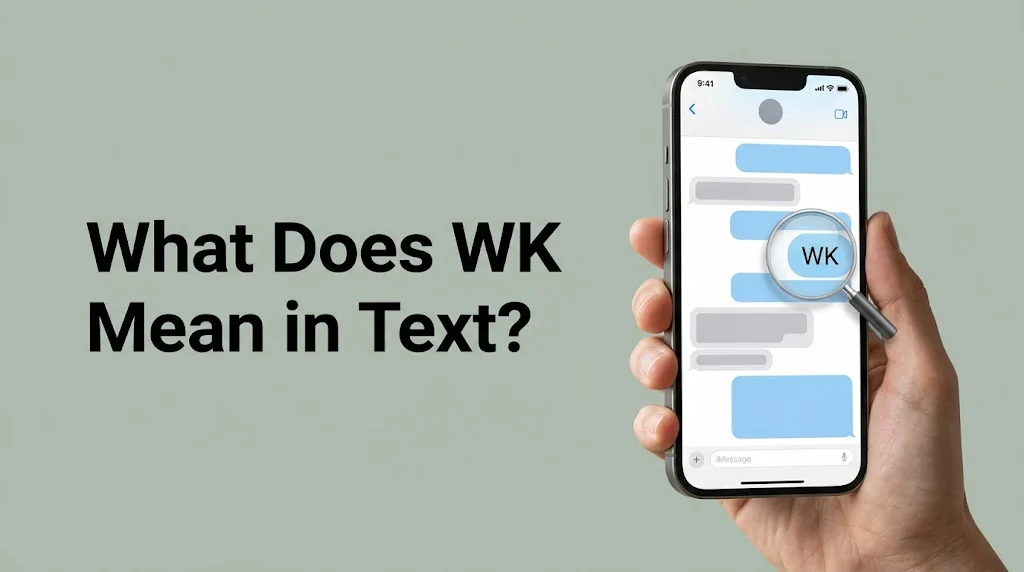
Have you received a text that says “See you next wk” or “I’ll finish it this wk” and wondered what WK means in text? You are not alone. Short forms are common in text messages, social media posts, online chats, and everyday conversations. However, some of them can have more than one meaning.
In most everyday messages, WK is a short written form of “week.” People use it to talk about plans, deadlines, school schedules, work shifts, holidays, and other events that happen during a seven-day period. For example, “I’ll call you next wk” means “I’ll call you next week.”
But context matters. In some messages, WK may stand for “work” or “weak.” Some people also use it for less common meanings, such as “who knows,” although these uses are not as widely established. The words around WK usually help you understand what the sender means By the end, you will know when WK is suitable, when to write the full word, and how to avoid confusion in personal and professional messages..
Definition & Meaning
WK usually means “week” in a text message. It is a short written abbreviation that saves space when people discuss dates, plans, schedules, or deadlines. For example, “next wk” means “next week.” Depending on the conversation, WK can also mean work or weak, so always check the surrounding words.
WK meaning at a glance
| Abbreviation | Possible meaning | Example | How to understand it |
|---|---|---|---|
| WK | Week | See you next wk. | See you next week. |
| WK | Work | At wk rn. | At work right now. |
| WK | Weak | That excuse was wk. | That excuse was weak. |
| WK | Who knows | WK what will happen. | Possible niche use; context is essential. |
| WK | Want to know | WK more? | Possible niche use; do not assume this meaning. |
Quick tip: If the message includes words such as next, this, last, every, or a number followed by WK, the sender probably means week.
Examples:
- “2 wks left” means two weeks left.
- “This wk is busy” means this week is busy.
- “Next wk works for me” means next week works for me.
Is WK an acronym or an abbreviation?
WK is best described as a written abbreviation when it means week. An acronym is usually formed from the first letters of a group of words and may be pronounced as a word, while an initialism is pronounced letter by letter.
People sometimes call every short form an acronym, but that is not always accurate. For everyday use, you do not need to worry about the technical label. Just remember that WK is a compact way to write week in suitable contexts.
Why We Use WK
People use WK to write “week” more quickly in short messages, schedules, notes, and online conversations. It helps save space and makes dates easier to scan. It is especially useful when the time period is already clear, such as in “next wk” or “3 wks left.” In formal writing, spelling out week is usually clearer.
1. To save time while texting
Typing a short form can make a message quicker to write.
Example:
“Are you free next wk?”
This means “Are you free next week?”
The meaning remains clear because the word next signals a time period.
2. To discuss plans
Friends and family often use WK when arranging meetups, trips, visits, or celebrations.
Example:
“Let’s go shopping this wk.”
The sender wants to go shopping sometime this week.
3. To talk about work schedules
Employees may use WK in personal notes or informal team chats.
Example:
“My shifts change next wk.”
This means the person’s work shifts will change next week.
For official schedules, however, the full word is often better.
4. To discuss school and college
Students may write WK when talking about exams, assignments, classes, or holidays.
Example:
“Our project is due in 2 wks.”
The project is due in two weeks.
5. To post on social media
People may use WK in captions, comments, or casual updates.
Example:
“Busy wk, but I made it!”
The person had a busy week and feels pleased to have finished it.
6. To write short notes
WK can fit well in planners, calendars, and personal reminders.
Example:
“Call dentist next wk.”
This is a reminder to call the dentist next week.
7. To make messages easier to scan
Short forms can help readers find dates and deadlines quickly in a list.
Example:
- Meeting: next wk
- Report: in 2 wks
- Holiday: last wk of June
The key is consistency. If other people need to understand your notes, clear language matters more than saving a few letters.
When should you avoid WK?
Avoid it when writing:
- Formal emails to clients or managers
- School essays and academic papers
- Legal documents
- Public instructions
- Messages to people who may not know the abbreviation
- Important deadlines where ambiguity could cause problems
Pro tip: Saving two or three letters is not worth creating confusion. Write week when the reader needs complete clarity.
Main Section: 60 Examples of WK in Text
The easiest way to understand WK is to see it in short messages. In the examples below, WK usually means week, while the surrounding sentence makes the meaning clear. A few examples show other possible interpretations so you can recognize them without assuming every use of WK has the same meaning.
The sample messages are illustrative examples, not claims that every phrase is a fixed or widely used slang expression.
Examples 1–10: Everyday texting
Example 1: “See you next wk.”
Meaning: See you next week.
Real explanation: The sender expects to see you during the following week.
Sample sentence: “I’m traveling now. See you next wk.”
When to use it: Casual messages to friends or relatives.
When NOT to use it: Formal invitations or official appointments.
Alternatives: “See you next week,” “Catch you next week,” “See you soon.”
Difficulty: Beginner. Tone: Informal.
Example 2: “How’s your wk going?”
Meaning: How is your week going?
Real explanation: The sender is asking how things have been over the past few days.
Sample sentence: “Hey! How’s your wk going so far?”
When to use it: Friendly check-ins.
When NOT to use it: Formal customer correspondence.
Alternatives: “How is your week?” “How have you been?” “How are things going?”
Difficulty: Beginner. Tone: Informal.
Example 3: “This wk is crazy.”
Meaning: This week is very busy or stressful.
Real explanation: The sender has a lot to do during the current week.
Sample sentence: “This wk is crazy. I have three exams.”
When to use it: Casual updates.
When NOT to use it: Formal reports.
Alternatives: “This week is hectic,” “I’m very busy this week,” “It’s a packed week.”
Difficulty: Beginner. Tone: Informal.
Example 4: “Talk to you next wk.”
Meaning: Talk to you next week.
Real explanation: The sender expects to speak with you again the following week.
Sample sentence: “I have to go now. Talk to you next wk!”
When to use it: Ending a casual conversation.
When NOT to use it: When a precise call time must be confirmed.
Alternatives: “Speak next week,” “Talk soon,” “I’ll call you next week.”
Difficulty: Beginner. Tone: Informal.
Example 5: “I’m free this wk.”
Meaning: I have free time this week.
Real explanation: The sender may be available for plans during the current week.
Sample sentence: “I’m free this wk if you want to meet.”
When to use it: Arranging social plans.
When NOT to use it: When exact availability is required.
Alternatives: “I’m available this week,” “I have time this week,” “My schedule is open.”
Difficulty: Beginner. Tone: Informal.
Example 6: “Maybe next wk?”
Meaning: Perhaps next week.
Real explanation: The sender is suggesting a later time, often because the current week is inconvenient.
Sample sentence: “I can’t make Friday. Maybe next wk?”
When to use it: Making flexible plans.
When NOT to use it: Confirming a fixed deadline.
Alternatives: “How about next week?” “Could we do it next week?” “Would next week work?”
Difficulty: Beginner. Tone: Informal.
Example 7: “It’s been a long wk.”
Meaning: It has been a tiring or difficult week.
Real explanation: The sender feels tired after several busy days.
Sample sentence: “Finally Friday! It’s been a long wk.”
When to use it: Sharing feelings with friends or coworkers.
When NOT to use it: Formal writing that requires a precise description.
Alternatives: “It’s been a tiring week,” “What a week,” “I’ve had a busy week.”
Difficulty: Beginner. Tone: Informal.
Example 8: “Same time next wk?”
Meaning: At the same time next week?
Real explanation: The sender wants to repeat an existing arrangement.
Sample sentence: “Coffee was fun. Same time next wk?”
When to use it: Scheduling regular meetups.
When NOT to use it: When the date or time needs to change.
Alternatives: “Same time next week?” “Can we meet again next week?” “Shall we do this again?”
Difficulty: Beginner. Tone: Informal.
Example 9: “I’ll be away all wk.”
Meaning: I will be away all week.
Real explanation: The sender expects to be absent for the whole week.
Sample sentence: “I’m visiting family, so I’ll be away all wk.”
When to use it: Letting people know you will be unavailable.
When NOT to use it: When only certain days are affected.
Alternatives: “I’ll be away all week,” “I’m gone for the week,” “I won’t be around this week.”
Difficulty: Beginner. Tone: Informal.
Example 10: “What’s your plan for the wk?”
Meaning: What are your plans for the week?
Real explanation: The sender is asking what you expect to do over the coming days.
Sample sentence: “What’s your plan for the wk? Want to hang out?”
When to use it: Friendly planning.
When NOT to use it: When you need a formal work schedule.
Alternatives: “What are you doing this week?” “Any plans this week?” “How does your week look?”
Difficulty: Beginner. Tone: Informal.
Examples 11–20: Dates, time, and planning
Example 11: “Only 1 wk left!”
Meaning: Only one week remains.
Real explanation: The sender is counting down to an event or deadline.
Sample sentence: “Only 1 wk left until our trip!”
When to use it: Countdown messages.
When NOT to use it: When the exact number of days matters.
Alternatives: “One week to go,” “Just seven days left,” “The event is next week.”
Difficulty: Beginner. Tone: Informal.
Example 12: “2 wks until vacation.”
Meaning: Two weeks remain until vacation.
Real explanation: The plural form wks stands for weeks.
Sample sentence: “2 wks until vacation. I can’t wait!”
When to use it: Casual countdowns and notes.
When NOT to use it: Formal documents requiring full words.
Alternatives: “Two weeks until vacation,” “Vacation is two weeks away,” “Two weeks to go.”
Difficulty: Beginner. Tone: Informal.
Example 13: “Can we move it to next wk?”
Meaning: Can we reschedule it for next week?
Real explanation: The sender wants to change an appointment or plan.
Sample sentence: “Something came up. Can we move it to next wk?”
When to use it: Flexible scheduling.
When NOT to use it: Without checking whether the new date suits everyone.
Alternatives: “Reschedule for next week,” “Push it to next week,” “Can we meet next week instead?”
Difficulty: Beginner. Tone: Informal.
Example 14: “I’m booked this wk.”
Meaning: I have many commitments this week.
Real explanation: The sender has little or no free time.
Sample sentence: “Sorry, I’m booked this wk. How about Monday?”
When to use it: Explaining limited availability.
When NOT to use it: If you are actually available and simply need to suggest a time.
Alternatives: “My schedule is full,” “I’m busy this week,” “I have a packed schedule.”
Difficulty: Beginner. Tone: Informal.
Example 15: “Let’s plan for next wk.”
Meaning: Let’s arrange it for next week.
Real explanation: The sender proposes the following week as the planning period.
Sample sentence: “We’re both busy, so let’s plan for next wk.”
When to use it: Early-stage planning.
When NOT to use it: When a specific date must be confirmed immediately.
Alternatives: “Let’s schedule it for next week,” “How about next week?” “Let’s arrange it soon.”
Difficulty: Beginner. Tone: Informal.
Example 16: “I get paid every wk.”
Meaning: I receive payment every week.
Real explanation: The sender is describing a weekly pay schedule.
Sample sentence: “I get paid every wk, so budgeting is easier.”
When to use it: Casual discussion about pay frequency.
When NOT to use it: Payroll forms or financial documents that require precise terms.
Alternatives: “I’m paid weekly,” “I get weekly pay,” “My pay comes every week.”
Difficulty: Beginner. Tone: Neutral.
Example 17: “I’ll finish it in a wk.”
Meaning: I will finish it in one week.
Real explanation: The sender expects the task to take about seven days.
Sample sentence: “The repairs should be done in a wk.”
When to use it: Casual estimates.
When NOT to use it: Contractual deadlines without a clear due date.
Alternatives: “Within a week,” “In seven days,” “By next week” (if the intended deadline matches).
Difficulty: Beginner. Tone: Neutral.
Example 18: “My birthday is next wk.”
Meaning: My birthday is next week.
Real explanation: The sender is sharing the timing of a birthday.
Sample sentence: “My birthday is next wk. Are you coming?”
When to use it: Personal messages and invitations.
When NOT to use it: When an exact date is needed to book or plan something.
Alternatives: “My birthday is next week,” “I turn another year older next week,” “My birthday is coming up.”
Difficulty: Beginner. Tone: Informal.
Example 19: “I need a wk off.”
Meaning: I need one week off.
Real explanation: The sender wants a seven-day period away from work, school, or other duties.
Sample sentence: “I’ve been exhausted. I need a wk off.”
When to use it: Casual conversations about rest or leave.
When NOT to use it: A formal leave request where dates and approval are required.
Alternatives: “I need a week off,” “I need seven days off,” “I need a week of leave.”
Difficulty: Beginner. Tone: Informal.
Example 20: “See you in 3 wks.”
Meaning: See you in three weeks.
Real explanation: The meeting or visit is expected three weeks from now.
Sample sentence: “Have a safe trip. See you in 3 wks!”
When to use it: Casual messages about future visits.
When NOT to use it: When the exact appointment date must be confirmed.
Alternatives: “See you in three weeks,” “See you in 21 days,” “I’ll see you later this month” (only if accurate).
Difficulty: Beginner. Tone: Informal.
Examples 21–30: School, work, and daily life
Example 21: “The test is next wk.”
Meaning: The test is next week.
Real explanation: The sender is sharing an upcoming test date.
Sample sentence: “The test is next wk, so I need to study.”
When to use it: Student group chats.
When NOT to use it: Official school notices that require the exact date.
Alternatives: “The test is next week,” “We have a test next week,” “Our exam is coming up.”
Difficulty: Beginner. Tone: Informal.
Example 22: “Our project is due in 2 wks.”
Meaning: The project deadline is two weeks away.
Real explanation: The sender is describing how much time remains.
Sample sentence: “Our project is due in 2 wks. Have you started?”
When to use it: Informal student or team chats.
When NOT to use it: Official assignment instructions where the precise deadline is needed.
Alternatives: “The project is due in two weeks,” “We have two weeks left,” “The deadline is in fourteen days.”
Difficulty: Beginner. Tone: Neutral.
Example 23: “I have meetings all wk.”
Meaning: I have meetings all week.
Real explanation: The sender has meetings scheduled throughout the week.
Sample sentence: “I have meetings all wk, but Friday may work.”
When to use it: Informal workplace messages.
When NOT to use it: A formal report or calendar entry.
Alternatives: “My week is full of meetings,” “I have meetings throughout the week,” “I’m in meetings all week.”
Difficulty: Beginner. Tone: Informal.
Example 24: “The new schedule starts next wk.”
Meaning: The new schedule begins next week.
Real explanation: A change to a timetable or routine will begin the following week.
Sample sentence: “The new schedule starts next wk, so check your shifts.”
When to use it: Informal team updates.
When NOT to use it: An official notice that should spell out dates.
Alternatives: “The new schedule starts next week,” “The timetable changes next week,” “The new plan begins next week.”
Difficulty: Beginner. Tone: Neutral.
Example 25: “I’m working late all wk.”
Meaning: I will work late all week.
Real explanation: The sender expects long workdays during the current week.
Sample sentence: “I’m working late all wk, so dinner may be difficult.”
When to use it: Explaining availability to friends or family.
When NOT to use it: As a substitute for an official work schedule.
Alternatives: “I have late shifts all week,” “I’ll be working late this week,” “My workdays will run late.”
Difficulty: Beginner. Tone: Informal.
Example 26: “Can you send the report this wk?”
Meaning: Can you send the report this week?
Real explanation: The sender wants the report before the current week ends.
Sample sentence: “Can you send the report this wk? We need it for review.”
When to use it: Informal work chats when the deadline is understood.
When NOT to use it: When a precise date and time are required.
Alternatives: “Please send it this week,” “Could you send it by Friday?” “Can you share the report before the week ends?”
Difficulty: Beginner. Tone: Neutral.
Example 27: “School starts in 2 wks.”
Meaning: School starts in two weeks.
Real explanation: The sender is counting down to the beginning of the school term.
Sample sentence: “School starts in 2 wks. I still need books.”
When to use it: Family and student conversations.
When NOT to use it: Official enrollment or school notices.
Alternatives: “School starts in two weeks,” “Two weeks until school begins,” “The term starts soon.”
Difficulty: Beginner. Tone: Informal.
Example 28: “I’m off work this wk.”
Meaning: I am not working this week.
Real explanation: The sender is on leave or has no shifts scheduled.
Sample sentence: “I’m off work this wk. Want to visit?”
When to use it: Casual planning.
When NOT to use it: When you need to specify paid leave, unpaid leave, or exact dates.
Alternatives: “I have this week off,” “I’m on leave this week,” “I don’t have work this week.”
Difficulty: Beginner. Tone: Informal.
Example 29: “We need to review this wk’s results.”
Meaning: We need to review this week’s results.
Real explanation: The sender refers to results from the current week.
Sample sentence: “We need to review this wk’s results before Monday.”
When to use it: Informal team notes.
When NOT to use it: A formal business report where full wording improves clarity.
Alternatives: “This week’s results,” “The results from this week,” “Our weekly results.”
Difficulty: Intermediate. Tone: Neutral.
Example 30: “I have a deadline every wk.”
Meaning: I have a deadline every week.
Real explanation: The sender has a recurring weekly deadline.
Sample sentence: “I have a deadline every wk, so I plan ahead.”
When to use it: Casual discussion about workload.
When NOT to use it: Formal documentation of project schedules.
Alternatives: “I have weekly deadlines,” “Something is due every week,” “My deadlines recur weekly.”
Difficulty: Beginner. Tone: Neutral.
Example 31: “What a wk!”
Meaning: What a week!
Real explanation: The sender has experienced a week that felt unusual, stressful, exciting, or eventful.
Sample sentence: “The trip, the exams, the late nights—what a wk!”
When to use it: Casual social posts or messages.
When NOT to use it: Formal summaries that need specific details.
Alternatives: “What a week,” “That was a lot,” “It’s been quite a week.”
Difficulty: Beginner. Tone: Informal.
Example 32: “Best day of the wk.”
Meaning: The best day of the week.
Real explanation: The sender is talking about a favorite day, perhaps Friday or Saturday.
Sample sentence: “Pizza and movies. Best day of the wk!”
When to use it: Casual captions and chats.
When NOT to use it: Formal writing.
Alternatives: “My favorite day of the week,” “The best day,” “A perfect day.”
Difficulty: Beginner. Tone: Informal.
Example 33: “Busy wk, good memories.”
Meaning: The week was busy but enjoyable or meaningful.
Real explanation: The sender is summarizing a busy period in a positive way.
Sample sentence: “Busy wk, good memories, and lots of photos.”
When to use it: Personal photo captions.
When NOT to use it: Professional updates requiring more detail.
Alternatives: “A busy but lovely week,” “A full week of memories,” “So much happened this week.”
Difficulty: Beginner. Tone: Informal.
Example 34: “This wk went too fast.”
Meaning: This week seemed to pass very quickly.
Real explanation: The sender feels that the week ended sooner than expected.
Sample sentence: “Monday was yesterday, right? This wk went too fast.”
When to use it: Casual conversation or a social post.
When NOT to use it: Formal writing where a more direct sentence is preferable.
Alternatives: “The week flew by,” “This week passed quickly,” “I can’t believe it’s already Friday.”
Difficulty: Beginner. Tone: Informal.
Example 35: “New goals for the wk.”
Meaning: New goals for the week.
Real explanation: The sender is sharing plans or aims for the coming days.
Sample sentence: “New goals for the wk: exercise, read, and sleep well.”
When to use it: Personal planning posts.
When NOT to use it: Official goal-setting documents without clear targets.
Alternatives: “Weekly goals,” “My goals for this week,” “Plans for the coming week.”
Difficulty: Beginner. Tone: Neutral.
Example 36: “Let’s catch up this wk.”
Meaning: Let’s talk or meet this week.
Real explanation: The sender wants to reconnect soon.
Sample sentence: “It’s been ages. Let’s catch up this wk!”
When to use it: Friends and acquaintances.
When NOT to use it: If you need to make a confirmed appointment without agreeing on a time.
Alternatives: “Let’s meet this week,” “Let’s talk soon,” “I’d love to hear how you’ve been.”
Difficulty: Beginner. Tone: Informal.
Example 37: “Hope your wk gets better.”
Meaning: I hope the rest of your week improves.
Real explanation: The sender is offering support after hearing about a difficult situation.
Sample sentence: “Sorry today was rough. Hope your wk gets better.”
When to use it: Supportive messages.
When NOT to use it: When the person needs direct help rather than a brief kind message.
Alternatives: “I hope things improve,” “Hope the rest of your week is easier,” “I’m rooting for you.”
Difficulty: Beginner. Tone: Informal.
Example 38: “First wk at my new job!”
Meaning: First week at my new job.
Real explanation: The sender is sharing a new career milestone.
Sample sentence: “First wk at my new job! Still learning, but loving it.”
When to use it: Personal updates and casual professional posts.
When NOT to use it: A formal employment announcement that requires polished wording.
Alternatives: “My first week at the new job,” “Week one at work,” “I’ve finished my first week.”
Difficulty: Beginner. Tone: Informal.
Example 39: “One more wk until we meet.”
Meaning: We will meet in one more week.
Real explanation: The sender is looking forward to a planned meeting.
Sample sentence: “One more wk until we meet. I’m excited!”
When to use it: Friends, family, or romantic partners.
When NOT to use it: When the date has not actually been agreed upon.
Alternatives: “One week until we meet,” “Seven days to go,” “I’ll see you next week.”
Difficulty: Beginner. Tone: Informal.
Example 40: “My favorite part of the wk is Sunday.”
Meaning: Sunday is the sender’s favorite part of the week.
Real explanation: The sender is expressing a personal preference.
Sample sentence: “Slow mornings and coffee. My favorite part of the wk is Sunday.”
When to use it: Casual discussions about routines.
When NOT to use it: Formal writing that calls for standard spelling.
Alternatives: “My favorite day is Sunday,” “I love Sundays,” “Sunday is the best day of the week.”
Difficulty: Beginner. Tone: Informal.
Examples 41–50: Questions, replies, and common situations
Example 41: “Which wk works for you?”
Meaning: Which week suits your schedule?
Real explanation: The sender wants you to choose a suitable week.
Sample sentence: “We can travel in May or June. Which wk works for you?”
When to use it: Planning future events.
When NOT to use it: If you mean a particular day rather than a week.
Alternatives: “Which week suits you?” “When are you available?” “What week is best?”
Difficulty: Beginner. Tone: Neutral.
Example 42: “Can we talk next wk instead?”
Meaning: Can we have the conversation next week instead?
Real explanation: The sender wants to postpone a discussion.
Sample sentence: “Today is hectic. Can we talk next wk instead?”
When to use it: Rescheduling a non-urgent discussion.
When NOT to use it: When the matter is urgent or time-sensitive.
Alternatives: “Can we talk next week?” “Could we postpone our chat?” “Can we speak another day?”
Difficulty: Beginner. Tone: Informal.
Example 43: “I’ll let you know this wk.”
Meaning: I will tell you sometime this week.
Real explanation: The sender expects to provide an answer before the week ends.
Sample sentence: “I’m waiting for confirmation. I’ll let you know this wk.”
When to use it: Casual updates.
When NOT to use it: If a specific response deadline has already been promised.
Alternatives: “I’ll update you this week,” “I’ll get back to you soon,” “I’ll confirm by Friday” (if accurate).
Difficulty: Beginner. Tone: Neutral.
Example 44: “How many wks do we have?”
Meaning: How many weeks remain?
Real explanation: The sender is asking about the time available before an event or deadline.
Sample sentence: “How many wks do we have before the competition?”
When to use it: Planning and countdowns.
When NOT to use it: When you need an exact number of days.
Alternatives: “How many weeks remain?” “How much time do we have?” “When is the deadline?”
Difficulty: Beginner. Tone: Neutral.
Example 45: “The next few wks will be busy.”
Meaning: The coming weeks will be busy.
Real explanation: The sender expects several demanding weeks ahead.
Sample sentence: “The next few wks will be busy, so let’s plan early.”
When to use it: Explaining future commitments.
When NOT to use it: When a precise date range is needed.
Alternatives: “The coming weeks will be hectic,” “I’ll be busy for a while,” “The next few weeks are packed.”
Difficulty: Beginner. Tone: Neutral.
Example 46: “I missed you this wk.”
Meaning: I missed you this week.
Real explanation: The sender is saying they wished they had seen or spoken with you during the week.
Sample sentence: “I missed you this wk. Let’s meet soon.”
When to use it: Personal or affectionate messages.
When NOT to use it: When the phrase could be misunderstood as a complaint without further context.
Alternatives: “I wish I’d seen you this week,” “I missed talking to you,” “I wanted to see you.”
Difficulty: Beginner. Tone: Informal.
Example 47: “Can you cover my shift next wk?”
Meaning: Can you work my shift next week?
Real explanation: The sender is asking someone to take a scheduled work shift.
Sample sentence: “Can you cover my shift next wk? I’ll return the favor.”
When to use it: Informal work scheduling.
When NOT to use it: Without following workplace rules for shift changes.
Alternatives: “Can you take my shift next week?” “Could we swap shifts?” “Are you available to cover me?”
Difficulty: Intermediate. Tone: Informal.
Example 48: “We start training in 1 wk.”
Meaning: Training starts in one week.
Real explanation: The sender is sharing the start time for a course or training program.
Sample sentence: “We start training in 1 wk, so finish the paperwork.”
When to use it: Informal team reminders.
When NOT to use it: In an official notice without the start date.
Alternatives: “Training begins in one week,” “Training starts next week,” “We have seven days before training.”
Difficulty: Beginner. Tone: Neutral.
Example 49: “This wk’s been better.”
Meaning: This week has been better.
Real explanation: The sender is comparing the current week with an earlier, less pleasant period.
Sample sentence: “Last week was rough, but this wk’s been better.”
When to use it: Personal updates.
When NOT to use it: In formal reports where a more exact comparison is needed.
Alternatives: “This week has improved,” “Things are better this week,” “It’s been a better week.”
Difficulty: Intermediate. Tone: Informal.
Example 50: “I’ll check again next wk.”
Meaning: I will check again next week.
Real explanation: The sender plans to revisit an issue after some time.
Sample sentence: “The item is out of stock. I’ll check again next wk.”
When to use it: Casual follow-ups.
When NOT to use it: When an urgent problem needs a quicker response.
Alternatives: “I’ll check next week,” “I’ll follow up next week,” “I’ll look into it again later.”
Difficulty: Beginner. Tone: Neutral.
Examples 51–60: Other meanings and context-dependent uses
These final examples show why context matters. The meanings below are not all equally common. In particular, interpreting WK as work or weak may fit a particular sentence, but week remains the safest starting point for general messages.
Example 51: “At wk rn.”
Meaning: At work right now.
Real explanation: In a conversation about someone’s location or availability, WK may be a personal shorthand for work.
Sample sentence: “Can’t talk long, at wk rn.”
When to use it: Private, casual chats where the recipient understands your shorthand.
When NOT to use it: Professional messages or conversations with unfamiliar people.
Alternatives: “At work right now,” “I’m working,” “I’m at my job.”
Difficulty: Intermediate. Tone: Informal.
Example 52: “Back to wk tomorrow.”
Meaning: Back to work tomorrow.
Real explanation: The sender is referring to returning to work after a break.
Sample sentence: “Weekend’s over. Back to wk tomorrow.”
When to use it: Informal messages to people who understand the abbreviation.
When NOT to use it: When wk might be read as week and cause confusion.
Alternatives: “Back to work tomorrow,” “I return to work tomorrow,” “Work starts again tomorrow.”
Difficulty: Intermediate. Tone: Informal.
Example 53: “That excuse was wk.”
Meaning: That excuse was weak or unconvincing.
Real explanation: In some online slang, WK may be intended as a clipped form of weak. This is less standard than writing the full word.
Sample sentence: “You forgot again? That excuse was wk.”
When to use it: Only in casual chats where the slang is understood.
When NOT to use it: Professional feedback or sensitive conversations.
Alternatives: “That excuse was weak,” “That wasn’t convincing,” “That’s a poor excuse.”
Difficulty: Advanced. Tone: Informal, potentially critical.
Example 54: “Your argument is wk.”
Meaning: Your argument is weak.
Real explanation: The writer may be using WK to criticize an argument, but many readers will find the abbreviation unclear.
Sample sentence: “I don’t agree. Your argument is wk because the facts don’t support it.”
When to use it: Informal online debate only when the meaning is clear.
When NOT to use it: Academic writing, work discussions, or respectful disagreement.
Alternatives: “Your argument is weak,” “Your point needs support,” “The evidence is not convincing.”
Difficulty: Advanced. Tone: Informal, critical.
Example 55: “That was a wk performance.”
Meaning: That was a weak performance.
Real explanation: The writer may be shortening weak to WK, but the form is not universally recognized.
Sample sentence: “The team can do better. That was a wk performance.”
When to use it: Familiar gaming or sports chats if the group understands the shorthand.
When NOT to use it: Public reviews or formal performance evaluations.
Alternatives: “That was a poor performance,” “The performance was disappointing,” “The team played badly.”
Difficulty: Advanced. Tone: Informal, critical.
Example 56: “WK what happens next.”
Meaning: Possibly “who knows what happens next,” depending on the sender’s personal shorthand.
Real explanation: Some users may use WK to mean who knows, but this is not a dependable, widely accepted texting definition.
Sample sentence: “We have no plan, WK what happens next.”
When to use it: Only when the recipient already understands this usage.
When NOT to use it: With new contacts or whenever a clear answer matters.
Alternatives: “Who knows what happens next?” “We’ll see,” “It’s hard to say.”
Difficulty: Advanced. Tone: Informal.
Example 57: “WK more about it?”
Meaning: Possibly “want to know more about it?” in a specific chat.
Real explanation: This interpretation is highly context-dependent. Many readers will not understand WK this way, so it should not be treated as a standard abbreviation.
Sample sentence: “I found a new course. WK more about it?”
When to use it: Only within a group that uses the shorthand consistently.
When NOT to use it: General texting, business messages, or public posts.
Alternatives: “Want to know more?” “Would you like more details?” “Should I tell you more?”
Difficulty: Advanced. Tone: Informal.
Example 58: “The task took 1 wk.”
Meaning: The task took one week.
Real explanation: This is a straightforward time abbreviation rather than a slang expression.
Sample sentence: “The task took 1 wk from start to finish.”
When to use it: Personal notes, quick summaries, and informal planning.
When NOT to use it: Formal reports where full wording or exact dates are preferred.
Alternatives: “The task took one week,” “It took seven days,” “The task lasted a week.”
Difficulty: Beginner. Tone: Neutral.
Example 59: “Wk 4 starts Monday.”
Meaning: Week 4 starts Monday.
Real explanation: In a course, training plan, project, or sports schedule, Wk 4 labels the fourth week.
Sample sentence: “Wk 4 starts Monday, so bring your completed workbook.”
When to use it: Timetables and numbered schedules.
When NOT to use it: When readers do not know how the weeks are numbered.
Alternatives: “Week 4 starts Monday,” “The fourth week begins Monday,” “The next training week starts Monday.”
Difficulty: Beginner. Tone: Neutral.
Example 60: “The final wk of the month.”
Meaning: The final week of the month.
Real explanation: The writer is identifying the last week of a month. The exact dates may depend on the calendar.
Sample sentence: “I’ll finish the move in the final wk of the month.”
When to use it: Casual planning or personal notes.
When NOT to use it: Contracts, bookings, or deadlines that require exact dates.
Alternatives: “The final week of the month,” “The last week of this month,” “The month’s closing week.”
Difficulty: Beginner. Tone: Neutral.
Quick lesson from all 60 examples
Most examples use WK to mean week. A few illustrate possible interpretations involving work, weak, who knows, or want to know. Those less common uses are included to show how context changes interpretation, not to suggest that they are equally common.
If you are unsure what a sender means, ask a simple question:
“Do you mean next week?”
That is clearer and safer than guessing.
Quick Reference Table
This table summarizes the main patterns used in the 60 examples. It helps readers identify WK quickly by looking at the words around it. Time words and numbers usually point to week, while references to a job or criticism may suggest work or weak. Unfamiliar meanings should be confirmed with the sender.
| No. | Example or pattern | Likely meaning | Best context |
|---|---|---|---|
| 1 | See you next wk | Next week | Friendly plans |
| 2 | How’s your wk going? | How is your week going? | Check-ins |
| 3 | This wk is crazy | Busy week | Personal updates |
| 4 | Talk to you next wk | Talk next week | Ending a chat |
| 5 | Free this wk | Available this week | Planning |
| 6 | Maybe next wk? | Perhaps next week | Rescheduling |
| 7 | Long wk | Tiring week | Casual conversation |
| 8 | Same time next wk? | Same time next week? | Repeat plans |
| 9 | Away all wk | Away all week | Availability |
| 10 | Plan for the wk | Plans for the week | Social planning |
| 11 | 1 wk left | One week remains | Countdown |
| 12 | 2 wks until vacation | Two weeks remain | Travel |
| 13 | Move it to next wk | Reschedule to next week | Appointments |
| 14 | Booked this wk | Busy this week | Scheduling |
| 15 | Plan for next wk | Plan for next week | General planning |
| 16 | Paid every wk | Paid weekly | Pay discussion |
| 17 | In a wk | In one week | Estimates |
| 18 | Birthday next wk | Birthday next week | Personal plans |
| 19 | A wk off | One week off | Leave or rest |
| 20 | In 3 wks | In three weeks | Future plans |
| 21 | Test next wk | Test next week | School |
| 22 | Due in 2 wks | Due in two weeks | Assignments |
| 23 | Meetings all wk | Meetings all week | Work |
| 24 | Schedule starts next wk | Starts next week | Timetables |
| 25 | Working late all wk | Working late all week | Availability |
| 26 | Report this wk | Report this week | Work deadline |
| 27 | School in 2 wks | School starts in two weeks | Education |
| 28 | Off work this wk | Not working this week | Personal plans |
| 29 | This wk’s results | This week’s results | Team updates |
| 30 | Deadline every wk | Weekly deadline | Workload |
| 31 | What a wk! | What a week! | Social posts |
| 32 | Best day of the wk | Best day of the week | Captions |
| 33 | Busy wk, good memories | Busy week | Social media |
| 34 | Wk went too fast | Week passed quickly | Casual chat |
| 35 | Goals for the wk | Weekly goals | Planning |
| 36 | Catch up this wk | Meet or talk this week | Friends |
| 37 | Hope your wk gets better | Hope the week improves | Support |
| 38 | First wk at my job | First week at work | Personal updates |
| 39 | One more wk until we meet | One week until meeting | Personal plans |
| 40 | Favorite part of the wk | Favorite part of the week | Conversation |
| 41 | Which wk works for you? | Which week suits you? | Scheduling |
| 42 | Talk next wk instead | Talk next week instead | Postponing |
| 43 | Let you know this wk | Update this week | Follow-up |
| 44 | How many wks? | How many weeks? | Time planning |
| 45 | Next few wks | Coming weeks | Future workload |
| 46 | Missed you this wk | Missed you this week | Personal chat |
| 47 | Cover my shift next wk | Cover next week’s shift | Work scheduling |
| 48 | Training in 1 wk | Training in one week | Training |
| 49 | This wk’s been better | This week has improved | Personal update |
| 50 | Check again next wk | Check next week | Follow-up |
| 51 | At wk rn | Possibly at work now | Informal shorthand |
| 52 | Back to wk tomorrow | Possibly back to work | Informal shorthand |
| 53 | Excuse was wk | Possibly weak | Casual criticism |
| 54 | Argument is wk | Possibly weak | Online debate |
| 55 | Wk performance | Possibly weak performance | Gaming or sports chat |
| 56 | WK what happens next | Possible “who knows” | Niche usage |
| 57 | WK more about it? | Possible “want to know” | Niche usage |
| 58 | Took 1 wk | Took one week | Task duration |
| 59 | Wk 4 starts Monday | Week 4 starts Monday | Numbered schedules |
| 60 | Final wk of the month | Final week of the month | Calendar planning |
Real-Life Conversations
In real conversations, WK is usually easy to understand when the topic is time or scheduling. The examples below show how it can appear in friendly chats, family plans, student discussions, and workplace messages. The wording is illustrative, and the full word week remains the clearer choice when the recipient may not know the abbreviation.
Conversation 1: Friends making plans
Mia: Are you free this weekend?
Alex: Not this one. My cousin’s visiting.
Mia: No worries. What about next wk?
Alex: That should work. Saturday afternoon?
Mia: Perfect. Let’s get lunch.
Alex: Sounds good. Text me the place later.
What does WK mean here?
WK means week. “Next wk” refers to next week, and the conversation makes the meaning clear because Mia and Alex are arranging a future meeting.
Conversation 2: A family group chat
Mom: Are you coming home this week?
Sam: I can’t this wk. I have exams.
Mom: Okay. How about next week?
Sam: Yes, probably Friday evening.
Mom: Let me know when you book your ticket.
Sam: Will do!
What does WK mean here?
It means week. Sam is explaining why a visit during the current week will not work.
Conversation 3: Students working on a project
Lena: When is our presentation due?
Noah: Next wk, I think.
Lena: I thought it was the week after.
Noah: Let me check the class page.
Lena: Please do. We need time to finish the slides.
Noah: You’re right. It’s due in two weeks.
What can we learn from this conversation?
Abbreviations do not replace the need to check important dates. Noah initially gives an uncertain answer, so checking the class page is better than relying on a guess.
Conversation 4: A workplace chat
Jordan: Can you review the draft this week?
Taylor: I’m booked all wk. Could I send feedback Monday?
Jordan: Monday works, as long as we can finalize it by Tuesday.
Taylor: Great. I’ll block time on my calendar.
Jordan: Thanks for letting me know.
What does WK mean here?
It means week. Although this informal exchange is understandable, a more formal email could say, “I’m fully booked this week.”
Conversation 5: Two people getting to know each other
Ava: How’s your week been?
Chris: Pretty busy, honestly. Yours?
Ava: Same here. Want to grab coffee next wk?
Chris: I’d like that! Are you free Thursday?
Ava: Thursday works. Let’s confirm the time closer to the day.
Chris: Sounds good 😊
What does WK mean here?
It means week. The message is friendly and casual. The abbreviation does not have a special romantic meaning in this conversation.
Everyday Usage
WK is mainly useful in informal writing where readers can easily recognize it as “week.” You may see it in text messages, personal notes, social captions, and some schedules. It is less suitable for formal essays, polished publications, and important business documents, where spelling out week makes the message easier to understand.
In everyday conversation
People generally say week, not the letters “W-K,” when speaking.
Written:
“See you next wk.”
Spoken:
“See you next week.”
If someone asks what WK means, explain that it is a written abbreviation rather than a word that people usually pronounce.
In writing and books
Books, essays, and edited articles normally use the full word week unless an abbreviation appears in a table, technical note, or specific style.
For example:
- Casual note: “Review in 2 wks.”
- Standard prose: “Review the results in two weeks.”
The second version is more natural in a published article.
In movies and TV shows
A character’s text message may show WK because short forms help make on-screen messages look compact. However, the appearance of an abbreviation in a fictional message does not mean that it is universal slang.
Example:
A character texts, “Back next wk.”
The intended meaning is “Back next week.”
In poetry and creative writing
A poet may use WK in a message, a diary-style poem, or a piece of experimental writing to suggest digital communication. In ordinary poetry, the full word often reads more naturally and gives the writer more control over rhythm.
Example:
“Seven days until the rain gives way; one more week, then you return.”
This works better for most poems than inserting WK without a clear stylistic reason.
In emails
Use week in most work emails.
Informal team message:
“Can we review this next wk?”
Polished email:
“Could we review this next week?”
For important deadlines, include the date:
“Could we review this on October 26?”
The exact date reduces confusion about what next week means.
In text messages
WK is suitable for short, friendly messages.
Examples:
- “See you next wk!”
- “Busy wk ahead.”
- “I’ll call you in 2 wks.”
- “Are you free this wk?”
These messages are usually clear because the context points to a period of time.
On Instagram
WK may appear in short captions, Stories, or informal comments.
Example:
“Busy wk, happy heart.”
The abbreviation gives the caption a casual style. A full-word caption, such as “A busy week and a happy heart,” is equally valid and easier for every reader to understand.
On Facebook
Friends may use WK when sharing plans or updates.
Example:
“First wk back at school. Ready for the weekend!”
For public posts, consider the audience. Some readers may not recognize less common abbreviations.
On X
Short posts can use compact language, including WK, when the meaning is clear.
Example:
“Two deadlines this wk. One step at a time.”
There is no need to force abbreviations into a post simply to save characters. Clear writing still matters.
On LinkedIn
LinkedIn is a professional network, so the full word week is generally preferable in polished posts.
Less polished:
“Great wk with the team!”
More polished:
“A great week of collaboration with the team.”
WK may be fine in an informal comment between colleagues, but it rarely adds value to a professional article or announcement.
In school assignments
Write week in essays, homework, and formal schoolwork.
Informal note:
“Read chapters 3–5 this wk.”
Assignment sentence:
“I completed chapters 3–5 this week.”
The full form shows that you understand standard written English.
Writing Tips
The best way to use WK is to match the formality of your message to the reader and the situation. It is usually clear in a casual text about dates, but the full word week is safer in formal writing. If the abbreviation could mean something else, write the full word or ask for clarification.
1. Know when to use it
Use WK when:
- You are texting a friend.
- The message is short and casual.
- The sentence clearly refers to time.
- The recipient knows common written abbreviations.
Example:
“Let’s talk next wk.”
Avoid it when:
- The message is a formal request.
- You are writing for an unfamiliar audience.
- The deadline affects money, work, travel, or attendance.
- You are unsure whether the recipient understands it.
2. Choose formal or informal wording
| Situation | Recommended wording | Why |
|---|---|---|
| Text to a friend | See you next wk. | Casual and understandable |
| Family group chat | Busy wk ahead! | Friendly and short |
| Email to a manager | I will follow up next week. | Clear and professional |
| School essay | The course lasts six weeks. | Standard written English |
| Project deadline | Please submit by October 26. | Gives a specific date |
| Public information page | The event takes place next week. | Easy for all readers |
3. Use abbreviations differently in speech and writing
WK is primarily a written form. When speaking, say week.
Written:
“I’ll be back in a wk.”
Spoken:
“I’ll be back in a week.”
Reading the letters aloud as “double-u kay” may confuse someone who expects the word week.
4. Understand American and British usage
The abbreviation wk is recognized in both American and British English. Standard dictionaries list it as a written abbreviation for week. Some dictionaries also record work and weak as meanings in particular contexts.
There is no major American-versus-British difference that changes the basic meaning of WK as week. The main issue is the level of formality and whether the reader recognizes the short form.
5. Consider children and adults
Children learning English should first learn to write week correctly. Once they understand the full word, they can learn that WK sometimes appears in informal messages.
Adults can use the abbreviation in casual chats, but they should not assume that every reader knows it. Clear writing is useful at every age.
6. Keep professional communication clear
A short abbreviation may save time, but it can also create uncertainty.
Instead of:
“Report due next wk.”
Write:
“Please submit the report by October 26.”
Use a specific date when the deadline matters. If the date is flexible, “next week” may be enough.
7. Use WK carefully in creative writing
A writer may use WK to make a character’s messages feel casual or digital. But the abbreviation should serve a purpose.
For example, a novel may show a character texting:
“Back next wk. Miss you.”
That can fit the character’s voice. In narration, however, “She would return next week” is usually smoother.
8. Do not confuse WK with similar abbreviations
Several short forms appear in the same kinds of messages:
- WK: Week, in common written use.
- WKND: Weekend.
- Wkly: Weekly, often in notes or schedules.
- Wks: Weeks, the plural form.
- W/E: Sometimes used for weekend, but its meaning depends on context.
These forms are not interchangeable. Use the one that matches what you want to say.
Common Mistakes
Most mistakes with WK happen when people assume it always means the same thing or use it in writing that needs to be clear and formal. The abbreviation usually means week, but other meanings are possible. The safest approach is to read the whole sentence, check the context, and spell out the word whenever there is doubt.
| Mistake | Reason | Correct version | Practical explanation |
|---|---|---|---|
| Assuming WK always means week | The abbreviation can have other meanings | Read the full sentence | Context helps identify the intended meaning |
| Using WK in every email | Short forms may look too casual | “I’ll reply next week” | Full words suit professional writing |
| Writing “wk” in an essay | Informal shorthand is not standard prose | “week” | School assignments usually require standard spelling |
| Confusing WK with WKND | They refer to different time periods | WK = week; WKND = weekend | One covers a week; the other means the weekend |
| Writing “1 wks” | The plural ending is incorrect | “1 wk” or “2 wks” | Use the singular with one and the plural with more than one |
| Treating WK as a romantic signal | The letters do not have a fixed romantic meaning | Interpret the whole message | The relationship and context matter more |
| Assuming WK means “who knows” | This is a niche, nonstandard interpretation | Ask what the sender means | Do not assume uncommon slang is universal |
| Using WK for an exact deadline | The timing may be unclear | Include the date and time | Precise deadlines prevent mistakes |
| Reading WK aloud as a word | It is a written abbreviation | Say “week” | The full word is normally spoken |
| Mixing abbreviations without a reason | Too many short forms make messages hard to read | Use familiar, consistent wording | Clarity is more valuable than extreme brevity |
| Assuming uppercase WK always means a different thing | Capitalization alone does not settle the meaning | Check the context | People use uppercase and lowercase inconsistently |
| Using WK when the reader may not know it | Not everyone uses texting shorthand | Write “week” | Standard wording reaches a wider audience |
Answer key and explanations
| Question | Answer | Explanation |
|---|---|---|
| 1 | B | Week is the most useful default interpretation in ordinary time-related messages. |
| 2 | C | “Next wk” is short for “next week.” |
| 3 | B | Spelling out the word makes a formal email clearer. |
| 4 | C | WKS is the plural abbreviation for weeks. |
| 5 | A | WKND is a common shorthand for weekend. |
| 6 | D | Asking prevents a misunderstanding. |
| 7 | B | The phrase refers to a future week. |
| 8 | C | WK is primarily used in writing; people normally say “week.” |
| 9 | D | A specific date removes uncertainty. |
| 10 | C | WK may have different meanings in different contexts. |
FAQs
1. What does WK mean in text from a girl or a guy?
WK usually means week when someone is discussing plans, dates, or schedules. It does not automatically have a romantic meaning just because a girl or guy sends it. For example, “See you next wk” simply means “See you next week.” Read the whole message before deciding whether the sender is expressing affection, making plans, or sharing information.
2. What does WK mean on WhatsApp?
On WhatsApp, WK commonly stands for week in casual messages. Someone might write, “I’ll call you next wk,” meaning they will call you next week. The app does not give the abbreviation a special meaning of its own. If the message is unclear, ask the sender what they mean rather than assuming it refers to a particular slang term.
3. What does WK mean on Instagram or Snapchat?
On Instagram or Snapchat, WK can mean week, especially in captions, direct messages, or discussions about plans. For example, “Busy wk!” means “Busy week!” It is not a universal platform-specific code. A different meaning is possible in a particular friend group, but the surrounding words and the conversation are more useful than the platform name alone.
4. Does WK mean week or work?
WK can mean either, but week is the safer default in ordinary texting. In “See you next wk,” it clearly means week. In a message such as “Back to wk tomorrow,” the sender may mean work. Because WK is not equally clear in both situations, writing the full word is the best choice whenever confusion is possible.
5. Is WK considered slang?
WK is usually better described as a written abbreviation when it means week. Slang uses may exist in certain online groups, including possible uses for weak or other phrases, but they are not equally common or reliable. The distinction matters because an abbreviation can be widely understood without being slang. In formal writing, use the full word week.
6. Is it correct to write WK or wk?
Both forms appear in everyday writing, and capitalization alone does not establish a different meaning. Lowercase wk is common in dictionaries and notes, while uppercase WK may appear in texts or headings. For normal prose, use week unless a style guide or context calls for the abbreviation. Consistency and clarity matter more than capitalization.
7. What is the plural of WK?
The common plural written form is wks, meaning weeks. For example, “2 wks left” means “two weeks left.” You can also write “2 weeks left,” which is clearer for a general audience. Use wk with one when following this shorthand, and wks with two or more. In formal writing, spell out the word.
8. Is WK appropriate for professional messages?
WK can work in a quick message to a colleague who understands the abbreviation, but it is not the best choice for formal emails, reports, or official deadlines. Write “next week” in polished communication and include an exact date when timing matters. A professional message should make the expected action and deadline easy to understand without guessing.
9. How should I reply when someone texts WK?
First, read the full sentence. If the sender writes “Are you free next wk?” you can reply, “Yes, next week works for me,” or “I’m busy next week, but I’m free the week after.” If you cannot tell whether WK means week, work, or something else, simply ask, “What do you mean by WK here?”
10. What is the difference between WK, WKND, and WKS?
WK commonly stands for week, WKND stands for weekend, and WKS stands for weeks. For example, “next wk” means next week, “this wknd” means this weekend, and “2 wks” means two weeks. These abbreviations are related, but they are not interchangeable. Use the full words when writing for readers who may not know the shorthand.
Related Terms
WK belongs to a wider group of abbreviations used in texting, scheduling, and online communication. Knowing the difference between WK, WKND, WKS, and similar forms helps you understand messages without guessing. The full word is usually best in formal writing, while familiar short forms can work well in casual chats.
WK vs. WKND vs. WKS
| Term | Full form | Example | Meaning |
|---|---|---|---|
| WK | Week | Next wk | Next week |
| WKND | Weekend | This wknd | This weekend |
| WKS | Weeks | 3 wks | Three weeks |
| WKLY | Weekly | WKLY update | An update that happens weekly |
| HR | Hour | 2 hr | Two hours |
| MIN | Minute | 10 min | Ten minutes |
| ASAP | As soon as possible | Reply ASAP | Reply as soon as possible |
| ETA | Estimated time of arrival | What’s your ETA? | When someone is expected to arrive |
| RN | Right now | Busy rn | Busy right now |
| TBH | To be honest | TBH, I’m tired | An honest or direct statement |
These forms have different meanings and purposes. WK and WKS refer to a period of time, while WKND refers specifically to the weekend. Other entries, such as ASAP and ETA, communicate urgency or expected timing.
WK vs. “week”
WK is shorter, but week is the standard full word. Both can communicate the same time period when the abbreviation is understood.
- Casual: “I’ll finish it next wk.”
- Standard: “I’ll finish it next week.”
The second sentence is usually the better choice for general writing.
WK vs. “weekly”
Week is a noun referring to a period of seven days. Weekly usually describes something that happens once a week or relates to a week.
Examples:
- “The course lasts six weeks.”
- “We have a weekly meeting.”
WK is not a direct replacement for weekly. In a schedule, a writer may use a separate shorthand such as wkly, but the full word is clearer.
WK vs. “weekend”
A week is a seven-day period, while a weekend usually refers to Saturday and Sunday in many American contexts. Local work schedules and cultural practices can differ.
Example:
- “I’m busy next wk” means busy next week.
- “I’m busy this wknd” means busy this weekend.
Choosing the wrong abbreviation can change the intended timing.
WK vs. “work”
Work refers to a job, labor, or an activity that needs to be done. Week refers to a period of time.
Compare:
- “I’ll be at work tomorrow.”
- “I’ll be away for a week.”
Because WK can be used as informal shorthand for either word in certain messages, spelling out the intended word avoids confusion.
WK vs. “weak”
Weak is an adjective meaning not strong, not convincing, or lacking force. WK may be used to represent weak in some niche online slang, but this is not the default interpretation for general texting.
Compare:
- “The plan needs another week.”
- “The plan is weak.”
The first sentence is about time. The second evaluates the quality of a plan.
WK vs. “who knows”
Some online users may assign WK a meaning such as who knows, but that interpretation is not sufficiently standard to assume without context. If a sender uses it this way, the rest of the message or the group’s established habits should make the meaning clear.
For a general audience, write “who knows?” in full.
Final Thoughts
WK usually means week in text messages. You may see it in phrases such as “next wk,” “this wk,” or “2 wks left.” It is a useful abbreviation for casual messages, reminders, schedules, and conversations about future plans. Other meanings are possible, but they depend on the context and are less reliable as general interpretations.
The best rule is simple: use WK when the message is casual and the meaning is clear. Use week in school assignments, formal emails, public information, and important deadlines. If someone sends you a message that could mean more than one thing, ask them to clarify.
You do not need to memorize every texting abbreviation to communicate well. Learn the common forms, pay attention to context, and choose clear words when the situation matters.
Discover more post
What Does WSIT Mean in Text? 2026
What Does MRD Mean in Text? 2026
What Does MOS Mean in Text? 2026

Zio Claruk ek professional content writer, English language educator, aur SEO specialist hain jo metasparik.com ke liye high-quality, user-friendly aur search-optimized content create karte hain. Unka focus simple English learning, literary devices, metaphors, similes, idioms, vocabulary building, aur practical writing guides par hota hai.