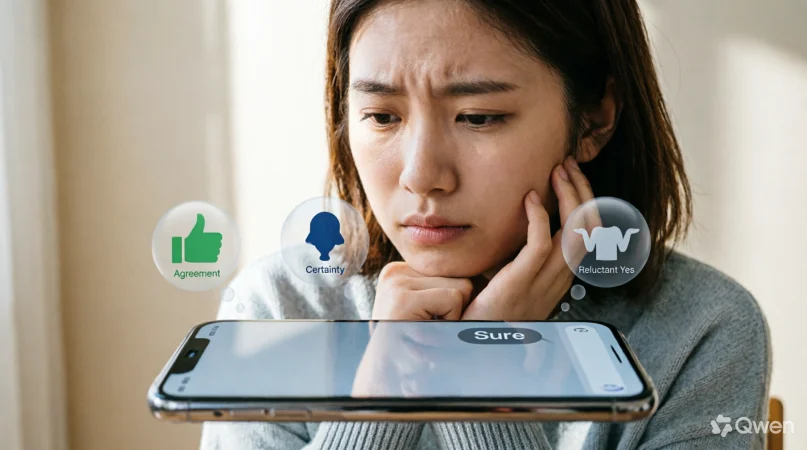
When someone texts “sure,” the basic meaning is usually “yes,” “okay,” or “I agree.” But a one-word reply can feel very different depending on the situation. “Sure!” may sound friendly and excited, while “sure.” can sometimes feel flat, reluctant, or even annoyed. That does not mean the sender is always upset. Text messages remove voice, facial expressions, and body language, so the reader has to use context to understand the tone.
People often search “what does sure mean in text?” because they receive a short reply and are unsure what the other person really means. This happens between friends, family members, coworkers, classmates, and romantic partners. It can also happen when someone replies to an invitation, request, question, or suggestion with only the word “sure.”
In everyday English, sure has several related meanings. It can express certainty, agreement, permission, willingness, or reassurance. Cambridge Dictionary lists “sure” as an informal adverb meaning “certainly” and gives examples where it is used to show agreement.
This 2026 guide explains the meaning of sure in text messages, how punctuation changes its tone, what “sure,” “sure!”, “sure?” and “SURE” can suggest, and how to reply naturally without overthinking a short message.
Definition & Meaning
In a text message, “sure” most often means “yes,” “okay,” or “I agree.” It can show that someone accepts an invitation, agrees to a request, or is willing to do something. However, the emotional tone can range from warm and enthusiastic to neutral or reluctant, depending on the words around it and the conversation.
Simple definition
Sure = yes / okay / certainly / I agree / I can do that.
For example:
“Can you send me the file?”
“Sure.”
This normally means:
“Yes, I can send it.”
The word itself is not automatically rude, cold, sarcastic, or romantic. The surrounding conversation matters.
Cambridge defines sure as an adjective meaning certain or without doubt, while the adverb sure can be used informally to mean “certainly” or to show agreement.
Quick meaning table
| Text | Most likely meaning | Possible tone |
|---|---|---|
| Sure | Yes / okay | Neutral |
| Sure! | Yes, definitely | Friendly |
| Sure!! | Yes! | Very enthusiastic |
| Sure 🙂 | Yes, happily | Warm |
| Sure 😊 | Yes | Friendly/warm |
| Sure thing | Definitely / no problem | Friendly |
| Sure, no problem | Yes, that’s fine | Helpful |
| Sure, why not? | Yes / I’m open to it | Casual |
| Sure… | Okay, but hesitant | Uncertain or reluctant |
| sure. | Okay | Neutral or possibly flat |
| SURE | Yes / emphasis | Strong, excited, or intense |
| Are you sure? | Do you really mean that? | Checking |
| Not sure | I don’t know / uncertain | Uncertain |
| For sure | Definitely | Confident |
| Sure enough | As expected | Confirming something |
| Sure, whatever | Fine, but possibly annoyed | Dismissive |
The easiest rule
If someone sends “sure” by itself, start with the simplest interpretation:
They probably mean yes.
Only look for a negative meaning if the rest of the conversation gives you a reason.
Why We Use “Sure” in Text
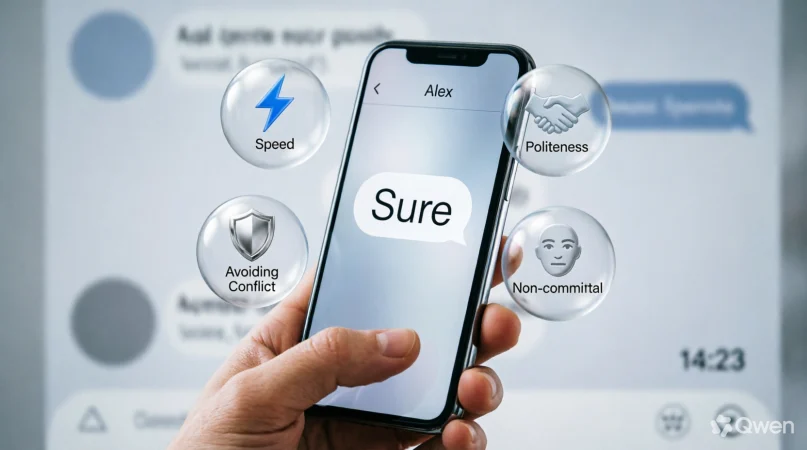
People use “sure” in texts because it is a short, natural way to agree, accept a request, give permission, or say they are willing to do something. It is common in casual conversation because it is faster and softer than a formal “I agree” or “I accept.” Its exact tone depends on context, punctuation, and the relationship between the people texting.
Practical purpose
“Sure” is useful because it can replace several longer replies:
- Yes.
- Okay.
- Of course.
- Certainly.
- No problem.
- I can do that.
- That works.
- I’m willing to.
- That’s fine.
For example:
“Want to grab coffee?”
Possible replies:
- “Yes.”
- “Okay.”
- “Sure.”
- “Absolutely!”
- “Sounds good.”
- “Of course.”
“Sure” is usually more casual than “certainly” and less enthusiastic than “absolutely!”
In everyday speaking
People say “sure” all the time:
“Can I borrow your charger?”
“Sure.”
“Want to come with us?”
“Sure!”
“Could you help me?”
“Sure, what do you need?”
Cambridge specifically lists sure as an informal adverb used to show agreement, such as replying “Sure” to an invitation.
In writing
“Sure” is perfectly normal in:
- Text messages
- Online chats
- Social media
- Casual emails
- Personal notes
- Dialogue in fiction
It can be less suitable in highly formal writing when a more precise expression is needed.
For example, instead of:
“Sure, we accept your proposal.”
A formal business message might say:
“We are pleased to accept your proposal.”
In school
Students may see “sure” in dialogue, stories, or informal communication.
Example:
“Can you help me with this question?”
“Sure.”
In an academic essay, however, the writer would normally choose more precise wording rather than using conversational “sure.”
On social media
“Sure” is common because social media communication is usually conversational.
Examples:
- “Sure 😂”
- “Sure thing!”
- “Sure, send it over.”
- “Sure lol.”
- “Yeah, sure.”
The added words and symbols can strongly affect how the message feels.
Main Section: 60+ Meanings and Examples of “Sure” in Text
“Sure” can communicate more than simple agreement in texting. It can mean yes, acceptance, willingness, reassurance, confidence, permission, or a reluctant agreement. The examples below show how small changes in punctuation, wording, and context can affect the likely meaning. The tone descriptions are practical interpretations, not fixed rules, because the same message can mean different things between different people.
Example 1: “Sure” = Yes
Meaning: The person agrees.
Real explanation: This is the most basic use. If you ask someone to do something and they answer “sure,” they usually mean yes.
Sample sentence:
“Can you pick me up at 7?”
“Sure.”
When to use it: Everyday requests and casual conversations.
When NOT to use it: When a formal or highly specific confirmation is required.
Alternatives: “Yes.” / “Okay.” / “Of course.”
Difficulty: Beginner
Tone: Neutral/casual
Example 2: “Sure!” = Friendly Yes
Meaning: Yes, happily.
Real explanation: The exclamation mark often adds energy and friendliness.
Sample sentence:
“Want to watch a movie tonight?”
“Sure!”
When to use it: Friends, family, casual chats.
When NOT to use it: Very formal business communication.
Alternatives: “Absolutely!” / “Sounds good!”
Difficulty: Beginner
Tone: Friendly
Example 3: “Sure!!” = Very Enthusiastic Yes
Meaning: Yes, definitely!
Real explanation: Multiple exclamation marks can make the response look more excited.
Sample sentence:
“Do you want to come to the concert?”
“Sure!!”
When to use it: Exciting plans.
When NOT to use it: Formal communication.
Alternatives: “Absolutely!” / “Definitely!”
Difficulty: Beginner
Tone: Enthusiastic
Example 4: “Sure thing” = Definitely
Meaning: Yes, no problem.
Real explanation: “Sure thing” is a friendly expression used to agree or offer help.
Sample sentence:
“Can you send that again?”
“Sure thing.”
When to use it: Casual conversation.
When NOT to use it: Highly formal documents.
Alternatives: “No problem.” / “Of course.”
Difficulty: Beginner
Tone: Friendly
Example 5: “Sure, no problem” = Willingness
Meaning: Yes, that’s fine.
Real explanation: The phrase removes much of the ambiguity of a one-word “sure.”
Sample sentence:
“Can you stay for ten more minutes?”
“Sure, no problem.”
When to use it: Requests and favors.
When NOT to use it: When you actually cannot help.
Alternatives: “Of course.” / “That’s fine.”
Difficulty: Beginner
Tone: Friendly/neutral
Example 6: “Sure, why not?” = Open to an Idea
Meaning: Yes, I’m willing to try it.
Real explanation: This phrase often shows casual acceptance without strong excitement.
Sample sentence:
“Want to try that new restaurant?”
“Sure, why not?”
When to use it: New ideas and casual plans.
When NOT to use it: When you need to express strong enthusiasm.
Alternatives: “Sounds good.” / “I’m up for it.”
Difficulty: Beginner
Tone: Casual
Example 7: “Sure :)” = Warm Agreement
Meaning: Yes, with a friendly feeling.
Real explanation: The smiley can make a short answer feel warmer.
Sample sentence:
“Can I call you later?”
“Sure :)”
When to use it: Friendly or personal chats.
When NOT to use it: Formal professional messages.
Alternatives: “Sure!” / “Of course 😊”
Difficulty: Beginner
Tone: Warm
Example 8: “Sure 😊” = Friendly Acceptance
Meaning: Yes, happily.
Real explanation: The emoji adds warmth, although its exact emotional meaning depends on the relationship.
Sample sentence:
“Want to get lunch tomorrow?”
“Sure 😊”
When to use it: Friends, family, dating.
When NOT to use it: Formal work communication unless emojis are normal in that workplace.
Alternatives: “Of course!” / “Sounds good 😊”
Difficulty: Beginner
Tone: Warm
Example 9: “Sure…” = Hesitation
Meaning: Okay, but I may not be happy about it.
Real explanation: Ellipses can make a short response sound hesitant or uncertain.
Sample sentence:
“Can you cover my shift again?”
“Sure…”
When to use it: Only if hesitation is genuinely intended.
When NOT to use it: If you want to sound clearly enthusiastic.
Alternatives: “I guess so.” / “Okay, if you need me to.”
Difficulty: Intermediate
Tone: Hesitant
Example 10: “sure.” = Flat or Neutral
Meaning: Okay.
Real explanation: A lowercase word followed by a period can look emotionally flat. But it is not automatically passive-aggressive.
Sample sentence:
“I’ll meet you at 6.”
“sure.”
When to use it: Casual texting.
When NOT to use it: When emotional warmth matters and the other person may misread a short answer.
Alternatives: “Okay!” / “Sounds good.”
Difficulty: Intermediate
Tone: Neutral/possibly cold
Example 11: “SURE” = Strong Emphasis
Meaning: Yes, definitely.
Real explanation: Capital letters usually add emphasis. Depending on context, they can express excitement or anger.
Sample sentence:
“Are you coming?”
“SURE!”
When to use it: Strong emphasis.
When NOT to use it: Formal writing.
Alternatives: “Definitely!” / “Absolutely!”
Difficulty: Beginner
Tone: Strong
Example 12: “Yeah, sure” = Agreement
Meaning: Yes, okay.
Real explanation: This is common in casual American English.
Sample sentence:
“Can we leave at eight?”
“Yeah, sure.”
When to use it: Casual conversation.
When NOT to use it: Formal business writing.
Alternatives: “Sure.” / “Yeah, that’s fine.”
Difficulty: Beginner
Tone: Casual
Example 13: “Yeah sure” = Casual Agreement
Meaning: Yes.
Real explanation: Without punctuation, this usually remains casual and direct.
Sample sentence:
“Can you help me later?”
“Yeah sure.”
When to use it: Friends and casual chats.
When NOT to use it: Formal communication.
Alternatives: “Sure.” / “Of course.”
Difficulty: Beginner
Tone: Casual
Example 14: “Oh sure” = Agreement or Sarcasm
Meaning: It can mean “yes,” but context matters.
Real explanation: “Oh sure” can be genuinely agreeable or sarcastic.
Sample sentence:
“Can you help me carry these?”
“Oh sure.”
When to use it: When the intended tone is clear.
When NOT to use it: When sarcasm might confuse the reader.
Alternatives: “Of course.” / “Sure.”
Difficulty: Intermediate
Tone: Neutral or sarcastic
Example 15: “Sure, I can” = Clear Willingness
Meaning: Yes, I am able and willing.
Real explanation: Adding “I can” removes uncertainty.
Sample sentence:
“Can you review my essay?”
“Sure, I can.”
When to use it: Requests.
When NOT to use it: If you are not actually available.
Alternatives: “Yes, I can.” / “Of course.”
Difficulty: Beginner
Tone: Helpful
Example 16: “Sure, I’ll do it” = Commitment
Meaning: Yes, I will do it.
Real explanation: This gives a clearer commitment than “sure” alone.
Sample sentence:
“Can you email the client?”
“Sure, I’ll do it.”
When to use it: Work or personal tasks.
When NOT to use it: If you do not intend to follow through.
Alternatives: “I will.” / “No problem.”
Difficulty: Beginner
Tone: Cooperative
Example 17: “Sure, later” = Agreement With a Time Limit
Meaning: Yes, but not now.
Real explanation: The second phrase gives an important timing detail.
Sample sentence:
“Can we talk?”
“Sure, later.”
When to use it: When you are busy.
When NOT to use it: If you want to reject the conversation.
Alternatives: “Sure, I’ll call later.” / “Okay, later.”
Difficulty: Beginner
Tone: Neutral
Example 18: “Sure, send it” = Permission
Meaning: Yes, you can send it.
Real explanation: Here “sure” grants permission.
Sample sentence:
“Can I send you the photo?”
“Sure, send it.”
When to use it: Sharing files, photos, links, or information.
When NOT to use it: If permission is unclear.
Alternatives: “Go ahead.” / “Yes, send it.”
Difficulty: Beginner
Tone: Casual
Example 19: “Sure, go ahead” = Permission
Meaning: You have permission.
Real explanation: This is stronger and clearer than a one-word response.
Sample sentence:
“Can I use your laptop?”
“Sure, go ahead.”
When to use it: Giving permission.
When NOT to use it: When you do not want the person to proceed.
Alternatives: “Go ahead.” / “That’s fine.”
Difficulty: Beginner
Tone: Friendly
Example 20: “Sure, why?” = Agreement Plus a Question
Meaning: Yes, but why?
Real explanation: The sender agrees while asking for more information.
Sample sentence:
“Can you call me?”
“Sure, why?”
When to use it: When the reason matters.
When NOT to use it: When you simply want to say yes.
Alternatives: “Sure. What’s up?” / “Okay, what happened?”
Difficulty: Beginner
Tone: Curious
Example 21: “Sure, what’s up?” = Ready to Listen
Meaning: Yes, tell me what you need.
Real explanation: This is common when someone asks to talk.
Sample sentence:
“Can I ask you something?”
“Sure, what’s up?”
When to use it: Friends, family, coworkers.
When NOT to use it: Very formal correspondence.
Alternatives: “Of course. What is it?” / “Sure. What’s going on?”
Difficulty: Beginner
Tone: Friendly
Example 22: “Sure, I guess” = Reluctant Agreement
Meaning: Probably yes, but I’m not excited.
Real explanation: “I guess” introduces uncertainty or reluctance.
Sample sentence:
“Want to come shopping?”
“Sure, I guess.”
When to use it: When genuine hesitation exists.
When NOT to use it: If you want to sound enthusiastic.
Alternatives: “I suppose.” / “Okay, I guess.”
Difficulty: Intermediate
Tone: Reluctant
Example 23: “Sure, whatever” = Possible Annoyance
Meaning: Fine; I don’t want to argue.
Real explanation: This phrase often signals frustration or dismissal.
Sample sentence:
“Let’s just do it your way.”
“Sure, whatever.”
When to use it: Only when the dismissive tone is intended.
When NOT to use it: Professional communication.
Alternatives: “Okay, that’s fine.” / “All right.”
Difficulty: Intermediate
Tone: Dismissive
Example 24: “Sure, if you want” = Indifference
Meaning: I’m okay with it, but it is your choice.
Real explanation: This often means the sender has no strong preference.
Sample sentence:
“Should we order pizza?”
“Sure, if you want.”
When to use it: Casual choices.
When NOT to use it: When you want to clearly recommend something.
Alternatives: “That’s fine with me.” / “If you’d like.”
Difficulty: Beginner
Tone: Neutral
Example 25: “Sure, sounds good” = Positive Agreement
Meaning: Yes, that plan works.
Real explanation: “Sounds good” makes the positive attitude clearer.
Sample sentence:
“Let’s meet at 5.”
“Sure, sounds good.”
When to use it: Plans and arrangements.
When NOT to use it: If you disagree.
Alternatives: “Works for me.” / “Sounds great.”
Difficulty: Beginner
Tone: Positive
Example 26: “Sure, absolutely” = Strong Agreement
Meaning: Definitely yes.
Real explanation: “Absolutely” strengthens the agreement.
Sample sentence:
“Can you help us?”
“Sure, absolutely.”
When to use it: Strong willingness.
When NOT to use it: If you are unsure.
Alternatives: “Definitely.” / “Of course.”
Difficulty: Beginner
Tone: Enthusiastic
Example 27: “Sure, of course” = Reassuring Yes
Meaning: Yes, naturally.
Real explanation: This can reassure the other person that the request is acceptable.
Sample sentence:
“Can I talk to you privately?”
“Sure, of course.”
When to use it: Personal or supportive situations.
When NOT to use it: When you want to create distance.
Alternatives: “Of course.” / “Absolutely.”
Difficulty: Beginner
Tone: Warm
Example 28: “Sure thing!” = Friendly Help
Meaning: Definitely; happy to help.
Real explanation: “Sure thing” is especially natural in informal American English.
Sample sentence:
“Can you grab some water?”
“Sure thing!”
When to use it: Casual requests.
When NOT to use it: Formal academic or legal writing.
Alternatives: “No problem!” / “You got it!”
Difficulty: Beginner
Tone: Friendly
Example 29: “Sure thing” = Confirmation
Meaning: Yes, that’s understood.
Real explanation: It can also confirm an arrangement.
Sample sentence:
“I’ll send it tonight.”
“Sure thing.”
When to use it: Casual confirmation.
When NOT to use it: Formal contracts.
Alternatives: “Okay.” / “Sounds good.”
Difficulty: Beginner
Tone: Casual
Example 30: “For sure” = Definitely
Meaning: Certainly.
Real explanation: “For sure” is a common informal phrase meaning without doubt.
Sample sentence:
“Are you coming tomorrow?”
“For sure.”
When to use it: Casual conversation.
When NOT to use it: Formal reports where “definitely” or “certainly” may be more suitable.
Alternatives: “Definitely.” / “Absolutely.”
Difficulty: Beginner
Tone: Confident
Example 31: “Sure enough” = As Expected
Meaning: Something happened as predicted.
Real explanation: This is different from simple agreement.
Sample sentence:
“He said he’d arrive early, and sure enough, he was there first.”
When to use it: Confirming an expectation.
When NOT to use it: As a basic reply to a request.
Alternatives: “As expected.” / “Just as predicted.”
Difficulty: Intermediate
Tone: Neutral
Example 32: “Are you sure?” = Checking Certainty
Meaning: Do you really mean that?
Real explanation: Here “sure” is about certainty, not agreement.
Sample sentence:
“I’ll drive home.”
“Are you sure?”
When to use it: Checking someone’s confidence or decision.
When NOT to use it: When no confirmation is needed.
Alternatives: “Really?” / “Are you certain?”
Difficulty: Beginner
Tone: Concerned or curious
Example 33: “You sure?” = Casual Confirmation
Meaning: Are you sure?
Real explanation: This is a shortened conversational form common in texting.
Sample sentence:
“I don’t need any help.”
“You sure?”
When to use it: Informal chats.
When NOT to use it: Formal writing.
Alternatives: “Are you sure?” / “Really?”
Difficulty: Beginner
Tone: Casual
Example 34: “I’m sure” = Confidence
Meaning: I believe this is true.
Real explanation: It expresses certainty.
Sample sentence:
“I’m sure she’ll call.”
When to use it: Giving your confident opinion.
When NOT to use it: When you have no evidence and need to express uncertainty.
Alternatives: “I’m certain.” / “I know.”
Difficulty: Beginner
Tone: Confident
Example 35: “I’m not sure” = Uncertainty
Meaning: I don’t know or don’t have enough confidence.
Real explanation: This is one of the most common meanings of “sure” outside simple agreement.
Sample sentence:
“What time does the movie start?”
“I’m not sure.”
When to use it: When you genuinely do not know.
When NOT to use it: When you know the answer clearly.
Alternatives: “I don’t know.” / “I’m uncertain.”
Difficulty: Beginner
Tone: Neutral
Example 36: “Not sure” = Maybe
Meaning: I don’t know yet.
Real explanation: It often leaves a decision open.
Sample sentence:
“Are you coming tonight?”
“Not sure.”
When to use it: Plans that are undecided.
When NOT to use it: When you have already decided.
Alternatives: “Maybe.” / “I haven’t decided.”
Difficulty: Beginner
Tone: Uncertain
Example 37: “I’m pretty sure” = High Confidence
Meaning: I believe it is true, but I am not 100% certain.
Sample sentence:
“Is this your book?”
“I’m pretty sure.”
When to use it: When confidence is high but not absolute.
When NOT to use it: If you know for certain.
Alternatives: “I think so.” / “I’m fairly certain.”
Difficulty: Beginner
Tone: Neutral
Example 38: “I’m almost sure” = Very Likely
Meaning: I strongly believe it is true.
Sample sentence:
“Did Sarah send the email?”
“I’m almost sure.”
When to use it: When there is slight doubt.
When NOT to use it: When you have definite proof.
Alternatives: “I’m nearly certain.” / “I think she did.”
Difficulty: Intermediate
Tone: Neutral
Example 39: “Not so sure” = Doubt
Meaning: I don’t fully agree or believe it.
Sample sentence:
“This is the best option.”
“I’m not so sure.”
When to use it: Polite disagreement.
When NOT to use it: If you strongly reject the idea.
Alternatives: “I’m not convinced.” / “I have some doubts.”
Difficulty: Intermediate
Tone: Polite
Example 40: “Sure about that?” = Doubt
Meaning: Are you confident about your statement?
Sample sentence:
“That happened yesterday.”
“Sure about that?”
When to use it: Informal questioning.
When NOT to use it: Formal disagreements.
Alternatives: “Are you certain?” / “Are you sure?”
Difficulty: Intermediate
Tone: Challenging
Example 41: “Make sure” = Remember to Check
Meaning: Take action so something is certain or done correctly.
Sample sentence:
“Make sure you lock the door.”
When to use it: Reminders and instructions.
When NOT to use it: When no action is needed.
Alternatives: “Be sure to…” / “Remember to…”
Difficulty: Beginner
Tone: Neutral
Example 42: “Be sure” = Remember
Meaning: Don’t forget.
Sample sentence:
“Be sure to call your mother.”
When to use it: Advice and reminders.
When NOT to use it: If the statement has no action attached.
Alternatives: “Remember to…” / “Don’t forget to…”
Difficulty: Beginner
Tone: Neutral
Example 43: “Be sure to” = Certain Instruction
Meaning: Remember to do something.
Sample sentence:
“Be sure to bring your ID.”
When to use it: Instructions and reminders.
When NOT to use it: Casual agreement.
Alternatives: “Make sure you…” / “Remember to…”
Difficulty: Beginner
Tone: Neutral
Example 44: “Sure?” = Asking for Confirmation
Meaning: Are you certain?
Sample sentence:
“I’ll leave now.”
“Sure?”
When to use it: Informal texting.
When NOT to use it: When the question could be misunderstood.
Alternatives: “Are you sure?” / “Really?”
Difficulty: Beginner
Tone: Curious
Example 45: “Sure!” After a Favor
Meaning: Happy to help.
Sample sentence:
“Can you take a look at this?”
“Sure!”
When to use it: Helpful responses.
When NOT to use it: If you cannot help.
Alternatives: “Of course!” / “Happy to.”
Difficulty: Beginner
Tone: Friendly
Example 46: “Sure.” After an Invitation
Meaning: Yes, I’ll come.
Sample sentence:
“Want to come over tonight?”
“Sure.”
When to use it: Casual invitations.
When NOT to use it: If you are undecided.
Alternatives: “Yeah, sure.” / “Sounds good.”
Difficulty: Beginner
Tone: Neutral
Example 47: “Sure!” After a Compliment
Meaning: Depending on context, it may mean acceptance or agreement.
Sample sentence:
“You look great today.”
“Sure!”
When to use it: Usually not as a natural direct response to a compliment unless the context explains it.
When NOT to use it: When “thank you” would be clearer.
Alternatives: “Thanks!” / “Thank you!”
Difficulty: Intermediate
Tone: Context-dependent
Example 48: “Sure lol” = Casual Acceptance
Meaning: Yes, in a joking or relaxed way.
Sample sentence:
“You really want me to come?”
“Sure lol.”
When to use it: Friends and playful chats.
When NOT to use it: Professional communication.
Alternatives: “Haha sure.” / “Yeah lol.”
Difficulty: Intermediate
Tone: Playful
Example 49: “Sure haha” = Light Agreement
Meaning: Yes, with humor or lightness.
Sample sentence:
“You think I should actually do it?”
“Sure haha.”
When to use it: Casual conversations.
When NOT to use it: Serious discussions.
Alternatives: “Yeah haha.” / “Sure 😂”
Difficulty: Intermediate
Tone: Playful
Example 50: “Sure 😂” = Humorous Agreement
Meaning: Yes, often with a joking tone.
Sample sentence:
“You want to wake up at 5 a.m.?”
“Sure 😂”
When to use it: Jokes and playful situations.
When NOT to use it: Serious requests.
Alternatives: “Absolutely 😂” / “Yeah right 😂”
Difficulty: Intermediate
Tone: Humorous
Example 51: “Sure babe” = Affectionate Agreement
Meaning: Yes, with an affectionate address.
Sample sentence:
“Can you call me later?”
“Sure babe.”
When to use it: Romantic or close relationships.
When NOT to use it: Professional or unfamiliar relationships.
Alternatives: “Of course, love.” / “Sure, sweetheart.”
Difficulty: Beginner
Tone: Affectionate
Example 52: “Sure love” = Affectionate or Friendly
Meaning: Yes, depending on regional and relationship context.
Sample sentence:
“Can you send that to me?”
“Sure, love.”
When to use it: Close relationships and some varieties of British English.
When NOT to use it: When the relationship is not familiar enough.
Alternatives: “Of course.” / “Sure, dear.”
Difficulty: Intermediate
Tone: Warm
Example 53: “Sure honey” = Affection
Meaning: Yes, with warmth.
Sample sentence:
“Can you help me?”
“Sure, honey.”
When to use it: Family or close relationships.
When NOT to use it: Professional communication.
Alternatives: “Of course.” / “Sure, dear.”
Difficulty: Beginner
Tone: Affectionate
Example 54: “Sure, I understand” = Acceptance
Meaning: I accept what you are saying.
Sample sentence:
“I need some time alone.”
“Sure, I understand.”
When to use it: Sensitive conversations.
When NOT to use it: If you do not actually understand.
Alternatives: “Okay, I understand.” / “Of course.”
Difficulty: Intermediate
Tone: Supportive
Example 55: “Sure, take your time” = Reassurance
Meaning: That’s okay; there is no rush.
Sample sentence:
“Sorry, I need another hour.”
“Sure, take your time.”
When to use it: Patient responses.
When NOT to use it: When there is a strict deadline.
Alternatives: “No rush.” / “That’s okay.”
Difficulty: Beginner
Tone: Reassuring
Example 56: “Sure, I guess” = Weak Agreement
Meaning: Okay, but I am not strongly convinced.
Sample sentence:
“Should we order this?”
“Sure, I guess.”
When to use it: Genuine uncertainty.
When NOT to use it: When you want to sound confident.
Alternatives: “I suppose.” / “Maybe.”
Difficulty: Intermediate
Tone: Hesitant
Example 57: “Sure, whatever you think” = Giving the Choice Away
Meaning: You decide.
Sample sentence:
“Should we leave now or later?”
“Sure, whatever you think.”
When to use it: When you genuinely have no preference.
When NOT to use it: If you actually have a strong opinion.
Alternatives: “Your call.” / “Whatever works for you.”
Difficulty: Intermediate
Tone: Neutral
Example 58: “Sure, if that works” = Conditional Agreement
Meaning: Yes, provided the situation works.
Sample sentence:
“Can we meet Thursday?”
“Sure, if that works.”
When to use it: Scheduling.
When NOT to use it: When you know Thursday is definitely available.
Alternatives: “That should work.” / “Thursday is fine.”
Difficulty: Intermediate
Tone: Neutral
Example 59: “Sure, whenever” = Flexible Agreement
Meaning: Any time is okay.
Sample sentence:
“When should I call?”
“Sure, whenever.”
When to use it: Flexible plans.
When NOT to use it: When you need a specific time.
Alternatives: “Anytime is fine.” / “Whenever works.”
Difficulty: Beginner
Tone: Casual
Example 60: “Sure, I’ll let you know” = Conditional Agreement
Meaning: Okay, I’ll give you an answer later.
Sample sentence:
“Are you coming to dinner?”
“Sure, I’ll let you know.”
When to use it: When you are undecided.
When NOT to use it: If you already know you are coming.
Alternatives: “I’ll let you know.” / “I’ll confirm later.”
Difficulty: Beginner
Tone: Neutral
Example 61: “Sure, no worries” = Reassurance
Meaning: That’s okay; don’t worry.
Sample sentence:
“Sorry I’m late.”
“Sure, no worries.”
When to use it: Minor problems or apologies.
When NOT to use it: Serious issues that need a more thoughtful response.
Alternatives: “No problem.” / “That’s okay.”
Difficulty: Beginner
Tone: Friendly
Example 62: “Sure, thanks” = Acceptance
Meaning: Yes, thank you.
Sample sentence:
“Want some coffee?”
“Sure, thanks.”
When to use it: Accepting an offer.
When NOT to use it: When you want to decline.
Alternatives: “Yes, please.” / “Sure, thank you.”
Difficulty: Beginner
Tone: Polite
Example 63: “Sure, please” = Accepting an Offer
Meaning: Yes, I would like that.
Sample sentence:
“Would you like some water?”
“Sure, please.”
When to use it: Informal spoken-style texting.
When NOT to use it: When a simple “Yes, please” is more natural.
Alternatives: “Yes, please.” / “Sure, thank you.”
Difficulty: Beginner
Tone: Polite
Example 64: “Sure, I’d love to” = Enthusiastic Acceptance
Meaning: Yes, I would really like to.
Sample sentence:
“Would you like to join us?”
“Sure, I’d love to.”
When to use it: Invitations.
When NOT to use it: When you are unsure.
Alternatives: “I’d love to.” / “Absolutely.”
Difficulty: Beginner
Tone: Warm/enthusiastic
Example 65: “Sure, maybe” = Mixed Signal
Meaning: Possibly, but not decided.
Sample sentence:
“Are you coming?”
“Sure, maybe.”
When to use it: Only when you genuinely have not decided.
When NOT to use it: When you want a clear answer.
Alternatives: “Maybe.” / “I’m not sure yet.”
Difficulty: Intermediate
Tone: Uncertain
Quick Reference Table
| Text expression | Likely meaning | Tone |
|---|---|---|
| Sure | Yes / okay | Neutral |
| Sure! | Yes | Friendly |
| Sure!! | Definitely yes | Excited |
| Sure thing | No problem | Friendly |
| Sure, no problem | Yes | Helpful |
| Sure, why not? | I’m willing | Casual |
| Sure 🙂 | Yes | Warm |
| Sure 😊 | Yes | Warm |
| Sure… | Okay, but hesitant | Reluctant |
| sure. | Okay | Flat/neutral |
| SURE | Yes, strongly | Emphatic |
| Yeah, sure | Yes | Casual |
| Oh sure | Yes / possibly sarcastic | Context-dependent |
| Sure, I can | Yes, I can | Helpful |
| Sure, I’ll do it | Yes, I will | Committed |
| Sure, later | Yes, later | Neutral |
| Sure, send it | Yes, go ahead | Permissive |
| Sure, go ahead | You have permission | Friendly |
| Sure, why? | Yes, explain | Curious |
| Sure, what’s up? | Yes, tell me | Friendly |
| Sure, I guess | Probably yes | Reluctant |
| Sure, whatever | Fine | Dismissive |
| Sure, if you want | Your choice | Indifferent |
| Sure, sounds good | That works | Positive |
| Sure, absolutely | Definitely | Enthusiastic |
| Sure, of course | Certainly | Warm |
| For sure | Definitely | Confident |
| Sure enough | As expected | Neutral |
| Are you sure? | Is that certain? | Checking |
| You sure? | Are you certain? | Casual |
| I’m sure | I believe it | Confident |
| I’m not sure | I don’t know | Uncertain |
| Not sure | Maybe / undecided | Uncertain |
| Pretty sure | Probably certain | Confident |
| Almost sure | Very likely | Neutral |
| Not so sure | I doubt it | Polite doubt |
| Make sure | Check / ensure | Instruction |
| Be sure | Remember | Reminder |
| Be sure to | Remember to do it | Instruction |
| Sure? | Really? | Questioning |
| Sure lol | Yes, jokingly | Playful |
| Sure haha | Yes, lightly | Playful |
| Sure 😂 | Yes, humorously | Humorous |
| Sure babe | Yes | Affectionate |
| Sure love | Yes | Warm |
| Sure honey | Yes | Affectionate |
| Sure, I understand | I accept that | Supportive |
| Sure, take your time | No rush | Reassuring |
| Sure, whatever you think | You decide | Flexible |
| Sure, if that works | Conditional yes | Neutral |
| Sure, whenever | Any time is fine | Flexible |
| Sure, I’ll let you know | I’ll decide later | Uncertain |
| Sure, no worries | That’s okay | Friendly |
| Sure, thanks | Yes, thank you | Polite |
| Sure, please | Yes, please | Polite |
| Sure, I’d love to | Yes, happily | Enthusiastic |
| Sure, maybe | Possibly | Uncertain |
Real-Life Conversations
The meaning of “sure” becomes much easier to understand when you see it in complete conversations. A single word does not carry all the emotional information in a text exchange. The message before it, the relationship between the speakers, punctuation, emojis, and what happens afterward all help reveal whether “sure” means enthusiastic agreement, simple acceptance, hesitation, or irritation.
Conversation 1: Friends
Alex: Want to grab coffee after work?
Sam: Sure!
Alex: Around 6?
Sam: Yeah, that works.
Meaning: Sam is clearly agreeing. The exclamation mark and follow-up answer make the tone positive.
Conversation 2: Family
Mom: Can you pick up some milk on your way home?
Daniel: Sure.
Mom: Thanks.
Daniel: No problem.
Meaning: The “sure” is simply a cooperative yes. There is no strong reason to interpret it as cold.
Conversation 3: Student and Teacher
Student: Can I submit the assignment tomorrow?
Teacher: You can, but please email me tonight.
Student: Sure, thank you.
Meaning: Here “sure” means the student accepts the instruction.
Conversation 4: Office
Manager: Could you send me the updated numbers before lunch?
Employee: Sure, I’ll send them in an hour.
Manager: Thanks.
Meaning: This is a clear professional agreement. The added promise makes the meaning precise.
Conversation 5: Dating
Maya: Want to get dinner Friday?
Chris: Sure 😊
Maya: Great. I know a nice place downtown.
Chris: Sounds good. What time?
Meaning: The emoji and follow-up question suggest positive interest. However, “sure” alone is not proof of romantic interest.
Conversation 6: Possible Frustration
A: Can we do it your way again?
B: Sure…
A: Are you okay?
B: Yeah. I’m just tired.
Meaning: The ellipsis may signal hesitation or low energy. Notice that the second message gives more information. It is better than assuming anger immediately.
Conversation 7: Social Media
Friend: You seriously want to post that?
You: Sure 😂
Friend: Haha okay.
Meaning: The emoji and context make the answer playful rather than formal.
Everyday Usage
“Sure” is one of those English words that moves easily between speech, texting, social media, and informal writing. Its core meaning stays connected to certainty or agreement, but the surrounding language changes its social effect. In conversation it is often natural and quick; in formal writing, a more exact expression may be better.
Conversation
“Sure” is extremely common in everyday speech.
“Can you help me?”
“Sure.”
It is often shorter and more natural than:
“Yes, I would be willing to assist you.”
That second sentence is grammatically fine but sounds unnatural in most ordinary conversations.
Writing
In personal writing, “sure” works well:
“Sure, I’ll call you tonight.”
In formal writing, consider the purpose:
“We are pleased to confirm that we accept the proposal.”
Books
Writers often use “sure” in dialogue because it sounds natural.
“Can you stay?”
“Sure.”
A novelist may also use punctuation to show character attitude:
“Sure…”
That can suggest hesitation, tiredness, or uncertainty.
Movies and TV
Spoken dialogue often uses “sure” because it is a natural conversational response.
Characters may say:
- “Sure.”
- “Sure!”
- “Sure thing.”
- “Are you sure?”
- “Yeah, sure.”
The actor’s voice and facial expression provide information that text messages do not.
Poetry
“Sure” can appear in poetry, but its use depends on the poet’s voice. It can express certainty, confidence, reassurance, or conversational intimacy.
Emails
“Sure” is appropriate in casual workplace emails when the culture is relaxed:
“Sure, I can send that over this afternoon.”
For a formal business situation:
“Certainly. I can send the document this afternoon.”
Text messages
Texting is where the word becomes most interesting.
Compare:
Sure.
Sure!
Sure 😊
Sure…
The dictionary meaning is similar, but the perceived tone can change.
Instagram, Facebook, and X
Social media often favors short conversational language.
Examples:
“Sure 😂”
“Sure thing!”
“Yeah, sure.”
“For sure!”
The surrounding post or comment matters more than the word alone.
“Sure” can still appear in casual LinkedIn messages, but professional alternatives may be better:
“Absolutely.”
“Certainly.”
“Happy to help.”
“Yes, that works for me.”
School assignments
Use “sure” naturally in dialogue:
“Can you help me?” she asked.
“Sure,” he replied.
But avoid using casual “sure” as a substitute for precise academic language.
Writing Tips
Use “sure” when you want a natural, conversational way to express agreement, certainty, or willingness. For formal writing, choose a more precise word when needed. In texting, remember that punctuation can change how a short answer feels. American and British English both use “sure,” although some expressions around it can vary by region and social group.
Best situations
“Sure” works especially well for:
- Casual requests
- Invitations
- Friendly conversations
- Quick confirmations
- Giving permission
- Offering help
- Informal emails
- Dialogue
Formal vs. informal
| Casual | More formal |
|---|---|
| Sure. | Certainly. |
| Sure thing. | Of course. |
| Yeah, sure. | Yes, certainly. |
| Sure, no problem. | Certainly, that is acceptable. |
| For sure. | Definitely / certainly. |
Do not replace every “sure” with “certainly.” They have different levels of formality.
Speaking vs. writing
In speech, your voice carries tone.
You can say:
“Sure.”
with warmth, annoyance, excitement, or sarcasm.
In text, readers cannot hear your voice. That is why:
“Sure!”
and
“Sure…”
may feel very different.
British vs. American usage
“Sure” is used in both American and British English.
However, some expressions can feel more common in particular varieties or regions. For example, “sure thing” is strongly associated with casual American English, while certain sentence-initial uses of “sure” have a notable role in Irish English.
Research on Irish English describes “sure” as a discourse marker that can signal shared understanding or expected agreement.
Children vs. adults
Children often use:
“Sure!”
Adults may use:
“Sure, no problem.”
Both can be perfectly natural.
The difference is usually related to vocabulary, social setting, and relationship rather than grammar.
Professional communication
If you are writing to a client, customer, professor, or senior manager, avoid vague one-word answers when the decision matters.
Instead of:
“Sure.”
try:
“Yes, that works for me.”
or:
“Certainly. I’ll send it by 3 p.m.”
That removes ambiguity.
Creative writing
Writers can use punctuation and word choice to show personality.
Compare:
“Sure,” she said.
“Sure!” she said.
“Sure…” she said.
The words are nearly identical, but the reader receives a different emotional signal.
Pro Tip
If someone sends “sure” and you are worried that they sound annoyed, do not immediately assume the worst.
Try:
“Just checking—does that work for you?”
That gives them a chance to clarify without starting an unnecessary conflict.
Did You Know?
The word sure has a much older meaning than its modern texting use. Merriam-Webster traces the adjective through Middle English and Old French roots connected with the idea of being safe or secure. Modern meanings developed around certainty, reliability, and confidence.
Common Mistakes
The biggest mistake is assuming that every “sure” has the same emotional meaning. A short text such as “sure” cannot be interpreted accurately without context. Another common mistake is treating punctuation as a fixed code. An exclamation mark may signal excitement, but different people use punctuation in different ways. Look at the whole conversation before deciding what the sender meant.
| Mistake | Reason | Correct approach | Practical explanation |
|---|---|---|---|
| Assuming “sure” always means excitement | “Sure” often just means yes | Check context | It may be neutral |
| Assuming “sure” always means anger | Short texts can look cold | Look at previous messages | The sender may simply text briefly |
| Treating “sure.” as rude | Periods have different texting habits | Consider the person’s normal style | Some people always use periods |
| Thinking “sure…” always means anger | Ellipses can show many emotions | Read the surrounding messages | It may mean hesitation or tiredness |
| Assuming “sure!” means romantic interest | Excitement is not romance | Consider the full relationship | Friends use it too |
| Reading “SURE” as shouting every time | Capital letters can be emphasis | Check context | It can mean excitement |
| Using “sure” in a formal report | It is conversational | Use precise formal wording | “Certainly” may fit better |
| Confusing “sure” with “surely” | They have different functions | Learn the difference | “Sure” can be an adjective/adverb; “surely” is an adverb |
| Replying “sure” when declining | It sends mixed signals | Say “No, sorry” | Be clear |
| Overanalyzing one-word texts | Context matters more than one word | Consider the full exchange | Tone is relational |
| Assuming “sure” means “I don’t care” | It can be neutral | Ask if necessary | Do not infer feelings without evidence |
| Using “sure, whatever” professionally | It can sound dismissive | Use “That works for me” | More professional |
Practice Exercise
Rewrite each sentence or reply using “sure” naturally. The goal is not simply to insert the word. Choose the version that matches the intended meaning and tone.
1. Accept an invitation
Original:
“Yes, I would like to come to the party.”
Possible rewrite:
“Sure, I’d love to come.”
2. Accept a simple request
Original:
“Yes, I can help you.”
Possible rewrite:
“Sure, I can help.”
3. Give permission
Original:
“Yes, you can use my phone.”
Possible rewrite:
“Sure, go ahead.”
4. Show uncertainty
Original:
“I don’t know if I can come.”
Possible rewrite:
“I’m not sure if I can come.”
5. Show confidence
Original:
“I am certain she will call.”
Possible rewrite:
“I’m sure she’ll call.”
6. Confirm something casually
Original:
“Yes, that time works for me.”
Possible rewrite:
“Sure, that works for me.”
7. Accept an offer
Original:
“Yes, thank you. I would like some.”
Possible rewrite:
“Sure, thanks.”
8. Show doubt
Original:
“I don’t completely believe that.”
Possible rewrite:
“I’m not so sure about that.”
9. Give a reminder
Original:
“Remember to bring your notebook.”
Possible rewrite:
“Be sure to bring your notebook.”
10. Confirm flexibility
Original:
“Any time is okay with me.”
Possible rewrite:
“Sure, whenever works.”
FAQs
What does “sure” mean in a text from a girl?
“Sure” from a girl usually means yes, okay, or I agree, just as it would from anyone else. It does not automatically mean she is interested, annoyed, excited, or uninterested. Look at the full conversation. “Sure!” followed by questions and emojis may feel warmer than a short “sure,” but texting style varies from person to person.
What does “sure” mean when a guy texts it?
When a guy texts “sure,” it usually means yes, okay, or that’s fine. The word alone does not reveal whether he is excited or annoyed. If he writes “Sure, sounds good,” the agreement is clearer. If he writes “sure…” or “sure, whatever,” there may be hesitation or frustration, depending on the context.
Does “sure” mean yes?
Yes. In many everyday conversations, “sure” means yes, especially when it answers a request or invitation. Cambridge Dictionary lists the informal adverb “sure” as a way to show agreement, with examples such as accepting an invitation. However, “sure” can also mean certain, as in “I’m sure.”
Is “sure” rude in texting?
Not by itself. “Sure” is normally a neutral or friendly way to agree. It may seem rude or cold when the conversation is tense, when the sender normally writes warmly but suddenly becomes very brief, or when it appears with dismissive words such as “whatever.” A period can also make it feel more serious, but punctuation habits differ between people.
What does “sure!” mean in a text?
“Sure!” normally means yes, definitely or yes, happily. The exclamation mark can make the answer feel more energetic than plain “sure.” For example, “Want to come with us?” followed by “Sure!” sounds like a friendly acceptance. Still, punctuation is not a perfect emotional code, so context remains important.
What does “sure…” mean in texting?
“Sure…” can suggest hesitation, reluctance, uncertainty, disappointment, or tiredness. The exact meaning depends on what came before it. For example, someone asked to do an unwanted task might reply “Sure…” reluctantly. Someone who is exhausted might use the same message without being angry. If you are unsure, ask instead of guessing.
What does “sure thing” mean in a text?
“Sure thing” is a casual way to say yes, definitely, or no problem. It is often friendly and helpful. For example: “Can you send me the address?” “Sure thing.” It is more conversational than “certainly” and is generally better suited to casual messages than highly formal business writing.
What does “are you sure?” mean in a text?
“Are you sure?” means “Are you certain?” The sender may be checking whether you really want to do something, whether your information is correct, or whether you have changed your mind. Depending on context, it can express concern, surprise, skepticism, or simple confirmation.
What does “sure, whatever” mean?
“Sure, whatever” often means “Fine, do what you want,” and it can sound dismissive or annoyed. The phrase is much more likely to carry negative emotion than a simple “sure.” It is usually best avoided in professional communication because the reader may interpret it as disrespectful or unwilling.
How should I reply to “sure”?
The best reply depends on what the person agreed to. If you were making plans, you can say “Great!”, “Sounds good!”, or confirm the details. If you are worried that “sure” sounded hesitant, ask “Does that work for you?” instead of assuming the person is upset.
Related Terms
“Sure” is closely connected to words such as “certain,” “definitely,” “okay,” “of course,” and “absolutely,” but these expressions are not interchangeable in every situation. Some express certainty, while others mainly express agreement or willingness. Knowing the difference helps you choose the right phrase in texts, conversations, school writing, and professional communication.
| Term | Main meaning | Typical tone | Example |
|---|---|---|---|
| Sure | Yes / certain | Casual/neutral | “Sure, I can help.” |
| Okay | Agreement/acceptance | Neutral | “Okay, I’ll do it.” |
| Yes | Direct agreement | Neutral | “Yes, I can.” |
| Of course | Strong agreement/reassurance | Warm | “Of course I can help.” |
| Certainly | Strong/formal agreement | Formal | “Certainly, I can assist.” |
| Definitely | Strong certainty | Confident | “Definitely.” |
| Absolutely | Very strong agreement | Enthusiastic | “Absolutely!” |
| Certainly not | Strong rejection | Formal | “Certainly not.” |
| Maybe | Possibility | Uncertain | “Maybe.” |
| Perhaps | Possibility | More formal | “Perhaps.” |
| Probably | Likely | Uncertain | “Probably.” |
| I guess | Weak agreement | Hesitant | “I guess so.” |
| For sure | Definitely | Casual/confident | “For sure!” |
| No problem | Willing agreement | Friendly | “No problem.” |
| Sounds good | Agreement with a plan | Friendly | “Sounds good.” |
| Fine | Acceptance | Neutral or potentially annoyed | “Fine.” |
| Whatever | Indifference/dismissal | Often negative | “Whatever.” |
Sure vs. okay
Sure can sound more willing than a bare okay.
“Can you help me?”
“Sure.”
often feels friendly.
“Can you help me?”
“Okay.”
can sound more neutral.
Neither is automatically rude.
Sure vs. absolutely
Absolutely is stronger.
“Sure” = yes.
“Absolutely!” = definitely yes!
Sure vs. definitely
Definitely strongly expresses certainty.
“Are you coming?”
“Definitely.”
This is more confident than a simple “sure.”
Sure vs. of course
Of course can add reassurance.
“Can I talk to you?”
“Of course.”
This may feel warmer than:
“Sure.”
Sure vs. fine
“Fine” is tricky because it can be neutral or annoyed.
“Fine, I’ll go.”
can sometimes sound reluctant.
“Sure” is generally safer when you mean friendly agreement.
How to Tell if “Sure” Sounds Cold
A short “sure” can feel cold, but the word alone is not enough evidence to conclude that someone is annoyed. Look for a change in the person’s normal texting style, negative words around “sure,” delayed or unusual responses, and the overall subject of the conversation. Tone should be interpreted from several signals rather than one punctuation mark or one word.
Consider these clues:
1. Look at the previous message
“Can you please send the file?”
“Sure.”
This is probably neutral.
But:
“Why do you never listen to me?”
“Sure.”
The context is much more emotionally charged.
2. Look at what comes after it
“Sure. What time?”
This is usually cooperative.
“Sure, whatever.”
This is more dismissive.
3. Compare the person’s normal style
If someone always writes:
“sure”
then the lowercase form means little.
If they normally write:
“Sure!!! 😊”
and suddenly switch to:
“sure.”
the change may be meaningful.
4. Do not treat punctuation as a universal code
Some people use periods in every message. Others rarely use them.
So:
“Sure.”
does not automatically mean:
“I’m angry.”
5. Consider the relationship
A close friend may use:
“Sure lol.”
A manager might use:
“Sure.”
Both can be perfectly appropriate in their settings.
What Should You Reply to “Sure”?
The best reply to “sure” depends on what the person agreed to. If they accepted an invitation, confirm the plan. If they agreed to help, give the needed details. If the message seems hesitant, ask a calm follow-up rather than guessing. A short “sure” usually does not require an emotional response or an explanation.
If they accepted your invitation
Reply:
“Great! See you at 7.”
If they agreed to help
Reply:
“Thanks! I’ll send it now.”
If they gave permission
Reply:
“Thanks, I appreciate it.”
If “sure” seems hesitant
Reply:
“Just checking—does that time work for you?”
If you think they are annoyed
Avoid:
“Why are you mad?”
Instead try:
“Everything okay?”
This keeps the conversation calm.
Final Thoughts
“Sure” usually means yes, okay, or I agree when it appears in a text message. It is one of the most useful casual words in English because it can accept a request, invitation, suggestion, or offer with very few words.
The tricky part is tone. “Sure,” “Sure!,” “sure.,” and “Sure…” can feel different, but none has a guaranteed emotional meaning. Context, punctuation, relationship, and the person’s normal texting style all matter.
If you are writing a message yourself, choose the version that clearly matches your intention. If you are interpreting someone else’s message, avoid reading too much into one word. Look at the entire conversation first.
When in doubt, a simple follow-up such as “Does that work for you?” or “Everything okay?” can clear up more than hours of guessing.
Discover more post
What Does PMS Mean in Text? 2026
What Does CJ Mean in Text? 2026
What Does EXT Mean in Text? 2026

Mia Stone ek professional English content writer, language educator, aur SEO specialist hain jo metasparik.com ke liye high-quality educational aur informational content create karti hain. Unka focus simple, easy aur user-friendly English learning guides par hota hai, jisse students aur beginners asaani se seekh saken.