
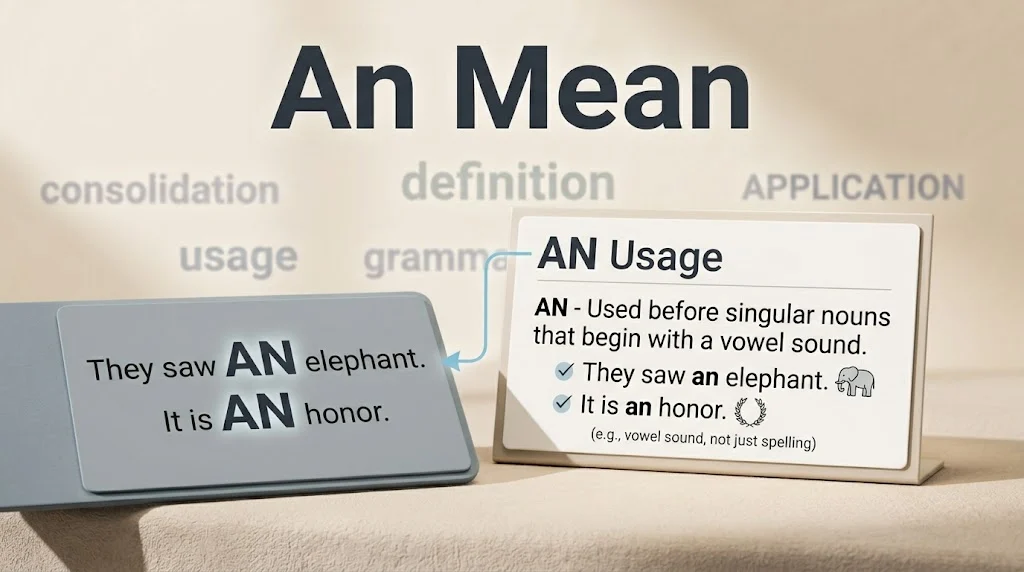
If you see the word “an” in a text, it usually has a simple grammar job: it comes before a singular countable noun when the noun is not being identified as a specific person or thing. For example, “I saw an elephant” means the writer saw one elephant, but the reader does not need to know which particular elephant. An is called the indefinite article, along with a. The important rule is that we normally use an before a vowel sound, not simply before a word beginning with a vowel letter. That is why we say an apple, an hour, and an interesting idea, but a university and a useful tool.
People often search for the meaning of “an” because they see it in texts, messages, books, school assignments, emails, or social media posts and wonder why the writer did not use a, the, or nothing at all. This guide explains the difference in plain English. You will learn what an means, when to use it, when not to use it, how pronunciation affects the choice, common mistakes, and more than 60 practical examples. The guide is for 2026 and is designed for beginners, students, writers, teachers, and anyone who wants to use everyday English more naturally.
Definition & Meaning
“An” is an English indefinite article used before a singular countable noun when the noun is not specific and the following word begins with a vowel sound. In simple terms, “an” often means “one” or “one of many,” without identifying exactly which person or thing is meant.
Simple definition
An = one, but not a particular one.
For example:
- an apple = one apple
- an idea = one idea
- an engineer = one engineer
- an old house = one old house
- an hour = one hour
Compare:
I need an umbrella.
The speaker needs one umbrella, but no particular umbrella has been identified.
Now compare:
I need the umbrella.
Here, the speaker and listener understand which umbrella is meant.
What part of speech is “an”?
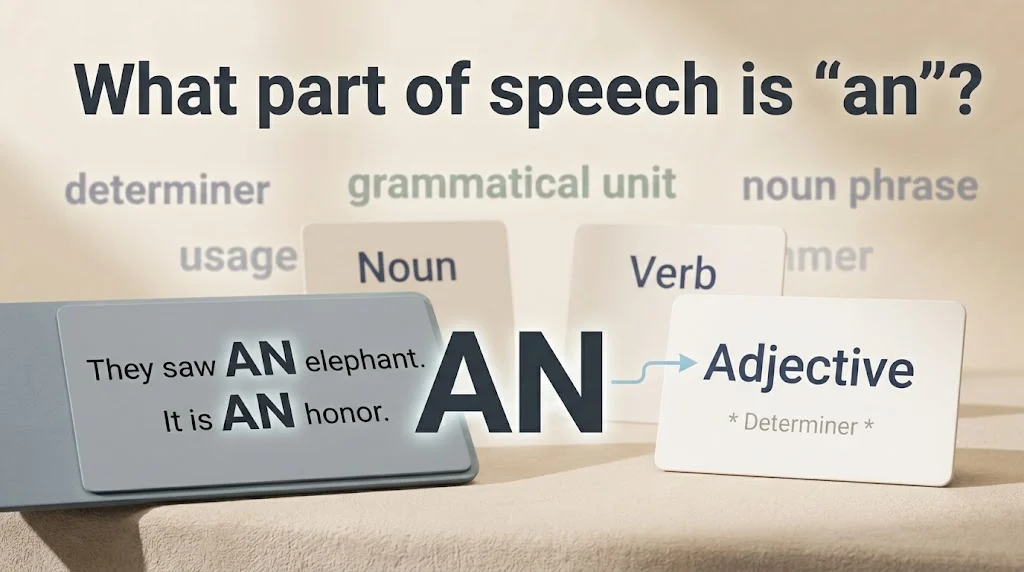
In traditional grammar, an is called an indefinite article. Modern grammar descriptions also treat a/an as a type of determiner. It comes before a noun or noun phrase and helps show how the writer or speaker is referring to that noun.
Quick explanation
Think of the three common choices this way:
- a/an → one thing, not specifically identified
- the → a particular thing that is identifiable
- no article → often used with plural nouns or uncountable nouns when speaking generally
For example:
I saw a dog.
The dog was wearing a red collar.
The first sentence introduces one dog without identifying it. The second sentence uses the because the dog is now known from the context.
Summary table
| Word | Basic meaning | Example | What it tells us |
|---|---|---|---|
| an | one, non-specific | an apple | One apple, not a particular apple |
| a | one, non-specific | a book | One book, not a particular book |
| the | specific | the book | A particular book |
| no article | general/plural/uncountable use | Books are useful. | Books in general |
Quick tip: Do not decide between a and an by looking only at spelling. Listen to the first sound.
Why We Use “An”
We use “an” to introduce or describe one non-specific singular countable noun when the next sound is a vowel sound. It helps readers understand that the writer means one member of a group rather than a particular, already-known person or thing. This makes sentences clearer and more natural in everyday English.
Practical purpose
The word an helps a reader understand that something is:
- Singular
- Countable
- Not specifically identified
- Introduced before a vowel sound
For example:
She bought an umbrella.
There is one umbrella. We do not know which umbrella.
Everyday usage
You hear an constantly in normal conversation:
I have an idea.
She needs an answer.
He found an old phone.
We waited for an hour.
The word is small, but removing it can make the sentence sound incorrect:
❌ I have idea.
✅ I have an idea.
Writing
Writers use an when introducing a singular countable noun:
We received an invitation yesterday.
Later, once the invitation is known:
The invitation arrived by email.
This movement from an to the is very common in English writing.
Speaking
In natural speech, an is usually pronounced weakly as /ən/:
an apple → /ən ˈæpəl/
It may sound almost like a very short “uhn.”
School
Students often meet an in grammar exercises, reading passages, essays, and vocabulary work.
A useful classroom rule is:
Use “an” before a vowel sound.
Examples:
- an apple
- an egg
- an elephant
- an orange
- an umbrella
- an idea
But remember:
- a university
- a European country
- a useful book
- a one-time event
These begin with consonant sounds, even though some begin with vowel letters.
Social media
The same grammar applies in texts, Instagram captions, Facebook posts, X posts, and comments.
“Just had an amazing day!”
“I have an announcement.”
Informal writing may ignore some grammar rules, but a/an usually works the same way in standard English.
Professional communication
Correct article use can make emails, reports, applications, and business writing sound more polished.
“We have identified an issue with the order.”
sounds more natural than:
“We have identified issue with the order.”
Main Section: 60+ Examples of “An”
The examples below show the most useful ways “an” appears in real English. In every case, “an” works with a singular countable noun or noun phrase beginning with a vowel sound. The examples cover everyday conversation, school, work, descriptions, pronunciation, numbers, abbreviations, and common situations.
Example 1: An apple
Meaning: One apple, not a particular apple.
Real explanation: “Apple” begins with the vowel sound /æ/, so an is used.
Sample sentence: I ate an apple after lunch.
When to use it: When referring to one non-specific apple.
When NOT to use it: Do not use an when talking about apples generally: “Apples are healthy.”
Alternatives: one apple; an item of fruit.
Difficulty: Beginner
Tone: Neutral
Example 2: An answer
Meaning: One answer that is not yet identified.
Real explanation: “Answer” begins with a vowel sound.
Sample sentence: I need an answer before Friday.
When to use it: When one answer is needed but the exact answer has not been identified.
When NOT to use it: Use the answer when both people know the specific answer.
Alternatives: one answer; a response.
Difficulty: Beginner
Tone: Neutral
Example 3: An idea
Meaning: One idea.
Real explanation: “Idea” begins with the vowel sound /aɪ/.
Sample sentence: I have an idea for the project.
When to use it: When introducing a new idea.
When NOT to use it: Do not use an with plural “ideas.”
Alternatives: one idea; a suggestion.
Difficulty: Beginner
Tone: Neutral
Example 4: An animal
Meaning: One animal, without saying which one.
Real explanation: “Animal” begins with a vowel sound.
Sample sentence: We saw an animal near the road.
When to use it: When the animal is not specifically identified.
When NOT to use it: “The animal” is better after the animal has already been identified.
Alternatives: one animal; a creature.
Difficulty: Beginner
Tone: Neutral
Example 5: An orange
Meaning: One orange.
Real explanation: “Orange” begins with a vowel sound.
Sample sentence: Would you like an orange?
When to use it: When offering one orange.
When NOT to use it: Use “oranges” without an for plural meaning.
Alternatives: one orange; an orange fruit.
Difficulty: Beginner
Tone: Neutral
Example 6: An egg
Meaning: One egg.
Real explanation: “Egg” begins with the vowel sound /e/.
Sample sentence: I had an egg for breakfast.
When to use it: For one egg.
When NOT to use it: Not with plural “eggs.”
Alternatives: one egg; a single egg.
Difficulty: Beginner
Tone: Neutral
Example 7: An elephant
Meaning: One elephant.
Real explanation: “Elephant” starts with a vowel sound.
Sample sentence: We saw an elephant at the zoo.
When to use it: For one non-specific elephant.
When NOT to use it: “The elephant” is used when a particular elephant is already known.
Alternatives: one elephant; a large animal.
Difficulty: Beginner
Tone: Neutral
Example 8: An umbrella
Meaning: One umbrella.
Real explanation: “Umbrella” begins with /ʌ/, a vowel sound.
Sample sentence: Take an umbrella because it may rain.
When to use it: When referring to one umbrella.
When NOT to use it: Do not use an before plural “umbrellas.”
Alternatives: one umbrella; a rain umbrella.
Difficulty: Beginner
Tone: Neutral
Example 9: An uncle
Meaning: One uncle.
Real explanation: “Uncle” begins with a vowel sound.
Sample sentence: I have an uncle in Chicago.
When to use it: When mentioning one uncle without identifying him by name.
When NOT to use it: Use “my uncle” when possession already identifies him.
Alternatives: one uncle; a relative.
Difficulty: Beginner
Tone: Neutral
Example 10: An aunt
Meaning: One aunt.
Real explanation: “Aunt” begins with a vowel sound in common American pronunciation.
Sample sentence: She has an aunt who lives nearby.
When to use it: When referring to one aunt.
When NOT to use it: Use “my aunt” when the relationship already identifies the person.
Alternatives: one aunt; a relative.
Difficulty: Beginner
Tone: Neutral
Example 11: An actor
Meaning: One actor.
Real explanation: “Actor” begins with a vowel sound.
Sample sentence: He wants to become an actor.
When to use it: Especially when describing someone’s job or goal.
When NOT to use it: Do not use an with plural “actors.”
Alternatives: one actor; a performer.
Difficulty: Beginner
Tone: Neutral
Example 12: An artist
Meaning: One artist.
Real explanation: “Artist” starts with a vowel sound.
Sample sentence: She is an artist.
When to use it: When describing a person’s profession, role, or identity.
When NOT to use it: “She is artist” is not standard English.
Alternatives: a painter; a creative professional.
Difficulty: Beginner
Tone: Neutral
Example 13: An engineer
Meaning: One engineer.
Real explanation: “Engineer” begins with a vowel sound.
Sample sentence: My brother is an engineer.
When to use it: When describing someone’s profession.
When NOT to use it: Do not leave out the article before a singular job title in standard English.
Alternatives: one engineer; a technical professional.
Difficulty: Beginner
Tone: Neutral
Example 14: An employee
Meaning: One employee.
Real explanation: “Employee” begins with a vowel sound.
Sample sentence: We hired an employee last month.
When to use it: When referring to one worker.
When NOT to use it: Use “employees” for more than one.
Alternatives: one worker; a staff member.
Difficulty: Beginner
Tone: Neutral
Example 15: An office
Meaning: One office.
Real explanation: “Office” begins with /ɒ/ or /ɑ/, depending on accent.
Sample sentence: She works in an office downtown.
When to use it: For one non-specific office.
When NOT to use it: Use “the office” when a particular workplace is known.
Alternatives: one office; a workplace.
Difficulty: Beginner
Tone: Neutral
Example 16: An apartment
Meaning: One apartment.
Real explanation: “Apartment” begins with a vowel sound.
Sample sentence: They rented an apartment near the station.
When to use it: When introducing one apartment.
When NOT to use it: Use “the apartment” after the particular apartment has become clear.
Alternatives: one apartment; a flat.
Difficulty: Beginner
Tone: Neutral
Example 17: An hour
Meaning: One hour.
Real explanation: The h in “hour” is silent. The word begins with the vowel sound /aʊ/.
Sample sentence: We waited for an hour.
When to use it: Always use an before “hour” in standard English.
When NOT to use it: Do not write “a hour.”
Alternatives: sixty minutes; one hour.
Difficulty: Beginner
Tone: Neutral
Example 18: An honest person
Meaning: One honest person.
Real explanation: The h in “honest” is silent, so the word begins with a vowel sound.
Sample sentence: He is an honest person.
When to use it: Before “honest” and similar words with a silent initial h.
When NOT to use it: “A honest person” is incorrect in standard English.
Alternatives: a truthful person; a sincere person.
Difficulty: Beginner
Tone: Neutral
Example 19: An heir
Meaning: One heir.
Real explanation: The initial h is silent.
Sample sentence: The king had an heir.
When to use it: Before “heir” because its first sound is a vowel.
When NOT to use it: Do not choose a simply because the spelling begins with H.
Alternatives: a successor; one heir.
Difficulty: Intermediate
Tone: Neutral
Example 20: An unusual problem
Meaning: One problem that is unusual.
Real explanation: The article comes before the adjective-plus-noun phrase. “Unusual” starts with a vowel sound.
Sample sentence: We found an unusual problem in the report.
When to use it: Before a singular countable noun phrase beginning with a vowel sound.
When NOT to use it: Do not say “a unusual problem.”
Alternatives: a strange problem; an unexpected issue.
Difficulty: Beginner
Tone: Neutral
Example 21: An interesting book
Meaning: One interesting book.
Real explanation: The article is chosen according to the first sound after it: “interesting” begins with a vowel sound.
Sample sentence: I found an interesting book yesterday.
When to use it: Before adjective + singular noun phrases beginning with a vowel sound.
When NOT to use it: “A interesting book” is incorrect.
Alternatives: an engaging book; a fascinating book.
Difficulty: Beginner
Tone: Neutral
Example 22: An expensive car
Meaning: One expensive car.
Real explanation: “Expensive” begins with a vowel sound.
Sample sentence: He bought an expensive car.
When to use it: When describing one non-specific car.
When NOT to use it: Use “the expensive car” if a specific car is already known.
Alternatives: a costly car; a high-priced car.
Difficulty: Beginner
Tone: Neutral
Example 23: An old house
Meaning: One old house.
Real explanation: “Old” starts with a vowel sound.
Sample sentence: They live in an old house.
When to use it: For one non-specific old house.
When NOT to use it: Not with plural “old houses.”
Alternatives: a historic house; an older home.
Difficulty: Beginner
Tone: Neutral
Example 24: An easy question
Meaning: One question that is easy.
Real explanation: “Easy” starts with a vowel sound.
Sample sentence: The teacher asked an easy question.
When to use it: Before “easy” + singular countable noun.
When NOT to use it: “A easy question” is incorrect.
Alternatives: a simple question; a basic question.
Difficulty: Beginner
Tone: Neutral
Example 25: An important meeting
Meaning: One important meeting.
Real explanation: “Important” begins with a vowel sound.
Sample sentence: I have an important meeting tomorrow.
When to use it: In both spoken and professional English.
When NOT to use it: Never use “a important” in standard English.
Alternatives: a key meeting; a significant meeting.
Difficulty: Beginner
Tone: Professional
Example 26: An American
Meaning: One American person.
Real explanation: “American” starts with a vowel sound.
Sample sentence: She is an American.
When to use it: When the nationality word functions as a singular countable noun.
When NOT to use it: Do not use an before every nationality adjective automatically.
Alternatives: an American person; a person from the United States.
Difficulty: Intermediate
Tone: Neutral
Example 27: An Australian
Meaning: One Australian person.
Real explanation: “Australian” starts with a vowel sound.
Sample sentence: I met an Australian at the conference.
When to use it: When the nationality word is being used as a noun.
When NOT to use it: With plural “Australians,” no an is needed.
Alternatives: an Australian person; someone from Australia.
Difficulty: Intermediate
Tone: Neutral
Example 28: An emergency
Meaning: One emergency situation.
Real explanation: “Emergency” begins with a vowel sound.
Sample sentence: Call for help if there is an emergency.
When to use it: For one emergency.
When NOT to use it: Do not use it before plural “emergencies.”
Alternatives: a crisis; an urgent situation.
Difficulty: Beginner
Tone: Neutral
Example 29: An accident
Meaning: One accident.
Real explanation: “Accident” begins with a vowel sound.
Sample sentence: There was an accident on the highway.
When to use it: When introducing an accident.
When NOT to use it: “The accident” refers to a particular accident already known.
Alternatives: a crash; an incident.
Difficulty: Beginner
Tone: Neutral
Example 30: An event
Meaning: One event.
Real explanation: “Event” starts with a vowel sound.
Sample sentence: We are planning an event for Saturday.
When to use it: For one non-specific event.
When NOT to use it: Use “the event” when the particular event is known.
Alternatives: a function; a gathering.
Difficulty: Beginner
Tone: Neutral
Example 31: An example
Meaning: One example.
Real explanation: “Example” begins with a vowel sound.
Sample sentence: Can you give me an example?
When to use it: When requesting or introducing one example.
When NOT to use it: Not before plural “examples.”
Alternatives: one example; a case.
Difficulty: Beginner
Tone: Neutral
Example 32: An explanation
Meaning: One explanation.
Real explanation: “Explanation” starts with a vowel sound.
Sample sentence: The student gave an explanation.
When to use it: When one explanation is being introduced.
When NOT to use it: “The explanation” means a particular explanation.
Alternatives: a reason; an account.
Difficulty: Beginner
Tone: Neutral
Example 33: An opportunity
Meaning: One opportunity.
Real explanation: “Opportunity” begins with a vowel sound.
Sample sentence: This is an opportunity to learn.
When to use it: Commonly used in education and professional writing.
When NOT to use it: Do not say “a opportunity.”
Alternatives: a chance; an opening.
Difficulty: Beginner
Tone: Neutral
Example 34: An appointment
Meaning: One scheduled meeting.
Real explanation: “Appointment” starts with a vowel sound.
Sample sentence: I have an appointment at three.
When to use it: For one scheduled appointment.
When NOT to use it: “The appointment” refers to a known appointment.
Alternatives: a meeting; a scheduled visit.
Difficulty: Beginner
Tone: Neutral
Example 35: An interview
Meaning: One interview.
Real explanation: “Interview” begins with a vowel sound.
Sample sentence: She has an interview tomorrow.
When to use it: For one interview.
When NOT to use it: Do not use an before plural “interviews.”
Alternatives: a job interview; a meeting.
Difficulty: Beginner
Tone: Neutral
Example 36: An email
Meaning: One email.
Real explanation: “Email” begins with a vowel sound.
Sample sentence: I received an email from my manager.
When to use it: For one email.
When NOT to use it: Use “emails” without an article for a plural general statement.
Alternatives: a message; one email.
Difficulty: Beginner
Tone: Neutral
Example 37: An article
Meaning: One article.
Real explanation: “Article” begins with a vowel sound.
Sample sentence: I read an article about grammar.
When to use it: When introducing one article.
When NOT to use it: Use “the article” when referring to a specific article already identified.
Alternatives: a piece; a written article.
Difficulty: Beginner
Tone: Neutral
Example 38: An author
Meaning: One author.
Real explanation: “Author” starts with a vowel sound.
Sample sentence: She is an author.
When to use it: When describing someone’s profession or role.
When NOT to use it: Do not omit the article in standard English: “She is author” is incorrect.
Alternatives: a writer; a novelist.
Difficulty: Beginner
Tone: Neutral
Example 39: An editor
Meaning: One editor.
Real explanation: “Editor” begins with a vowel sound.
Sample sentence: He works as an editor.
When to use it: For a profession or role.
When NOT to use it: Not before plural “editors.”
Alternatives: a copy editor; a content editor.
Difficulty: Beginner
Tone: Professional
Example 40: An online course
Meaning: One online course.
Real explanation: “Online” starts with a vowel sound.
Sample sentence: I joined an online course.
When to use it: When mentioning one course.
When NOT to use it: “Online courses” is plural and does not take an.
Alternatives: a digital course; a web-based course.
Difficulty: Beginner
Tone: Neutral
Example 41: An app
Meaning: One application.
Real explanation: “App” begins with a vowel sound.
Sample sentence: I downloaded an app for learning English.
When to use it: In everyday technology language.
When NOT to use it: Do not use an with plural “apps.”
Alternatives: an application; one mobile app.
Difficulty: Beginner
Tone: Informal
Example 42: An email address
Meaning: One email address.
Real explanation: “Email” is the first pronounced word in the noun phrase and begins with a vowel sound.
Sample sentence: Please send me an email address.
When to use it: When referring to one address.
When NOT to use it: Do not use an before plural “email addresses.”
Alternatives: one email address; a contact address.
Difficulty: Beginner
Tone: Neutral
Example 43: An issue
Meaning: One problem or matter.
Real explanation: “Issue” begins with a vowel sound.
Sample sentence: We found an issue with the software.
When to use it: Very common in workplace communication.
When NOT to use it: Use “the issue” when the specific problem is already known.
Alternatives: a problem; a concern.
Difficulty: Beginner
Tone: Professional
Example 44: An error
Meaning: One mistake.
Real explanation: “Error” starts with a vowel sound.
Sample sentence: There is an error in the report.
When to use it: For one error.
When NOT to use it: “The error” refers to a particular error already identified.
Alternatives: a mistake; a fault.
Difficulty: Beginner
Tone: Neutral
Example 45: An update
Meaning: One new piece of information.
Real explanation: “Update” begins with a vowel sound.
Sample sentence: I have an update for you.
When to use it: Common in emails, meetings, and messages.
When NOT to use it: Use “updates” for multiple pieces of new information.
Alternatives: a news update; new information.
Difficulty: Beginner
Tone: Neutral
Example 46: An announcement
Meaning: One announcement.
Real explanation: “Announcement” begins with a vowel sound.
Sample sentence: The company made an announcement.
When to use it: For one public or formal statement.
When NOT to use it: Not with plural “announcements.”
Alternatives: a statement; a public notice.
Difficulty: Beginner
Tone: Neutral
Example 47: An answer to a question
Meaning: One answer to one question.
Real explanation: “Answer” starts with a vowel sound, so an is required.
Sample sentence: I finally found an answer to the question.
When to use it: When introducing an answer.
When NOT to use it: “The answer” is better if the answer is already identified.
Alternatives: a response; one solution.
Difficulty: Intermediate
Tone: Neutral
Example 48: An important point
Meaning: One important point.
Real explanation: “Important” begins with a vowel sound.
Sample sentence: She made an important point.
When to use it: Common in essays, meetings, and discussions.
When NOT to use it: Not “a important point.”
Alternatives: a key point; a major point.
Difficulty: Beginner
Tone: Professional
Example 49: An early start
Meaning: One start that happens early.
Real explanation: “Early” begins with a vowel sound.
Sample sentence: We had an early start this morning.
When to use it: In everyday speech and writing.
When NOT to use it: Do not use a before “early.”
Alternatives: an early beginning; a start before usual.
Difficulty: Beginner
Tone: Neutral
Example 50: An excellent idea
Meaning: One idea described as excellent.
Real explanation: The article is based on “excellent,” which starts with a vowel sound.
Sample sentence: That is an excellent idea.
When to use it: When praising a singular idea.
When NOT to use it: “A excellent idea” is incorrect.
Alternatives: a great idea; a wonderful suggestion.
Difficulty: Beginner
Tone: Friendly
Example 51: An exciting game
Meaning: One exciting game.
Real explanation: “Exciting” begins with a vowel sound.
Sample sentence: We watched an exciting game.
When to use it: Before an adjective beginning with a vowel sound.
When NOT to use it: Not “a exciting game.”
Alternatives: a thrilling game; a fun match.
Difficulty: Beginner
Tone: Informal
Example 52: An unusual situation
Meaning: One situation that is unusual.
Real explanation: “Unusual” begins with a vowel sound.
Sample sentence: It was an unusual situation.
When to use it: When describing one situation.
When NOT to use it: Not before plural “situations.”
Alternatives: a strange situation; an uncommon case.
Difficulty: Beginner
Tone: Neutral
Example 53: An empty room
Meaning: One room that is empty.
Real explanation: “Empty” begins with a vowel sound.
Sample sentence: We found an empty room upstairs.
When to use it: For one room.
When NOT to use it: Not with plural “empty rooms.”
Alternatives: a vacant room; an unused room.
Difficulty: Beginner
Tone: Neutral
Example 54: An open door
Meaning: One door that is open.
Real explanation: “Open” starts with a vowel sound.
Sample sentence: I noticed an open door.
When to use it: When introducing one open door.
When NOT to use it: “The open door” refers to a particular known door.
Alternatives: a doorway left open; an unlocked entrance.
Difficulty: Beginner
Tone: Neutral
Example 55: An eight-year-old child
Meaning: One child who is eight years old.
Real explanation: “Eight” begins with a vowel sound, so an is used before the complete noun phrase.
Sample sentence: They have an eight-year-old child.
When to use it: Before age expressions beginning with a vowel sound.
When NOT to use it: Do not say “a eight-year-old child.”
Alternatives: an eight-year-old; a child aged eight.
Difficulty: Intermediate
Tone: Neutral
Example 56: An 18-year-old student
Meaning: One student who is 18 years old.
Real explanation: Read “18” as “eighteen,” which begins with a vowel sound.
Sample sentence: The program accepts an 18-year-old student.
When to use it: When the number is pronounced with a vowel sound.
When NOT to use it: Choose the article based on pronunciation, not the written numeral alone.
Alternatives: an 18-year-old; a student aged 18.
Difficulty: Intermediate
Tone: Neutral
Example 57: An MBA
Meaning: One MBA qualification or, depending on context, a person with an MBA.
Real explanation: “MBA” is pronounced “em-bee-ay,” beginning with the vowel sound /e/.
Sample sentence: She has an MBA.
When to use it: When the abbreviation begins with a vowel sound.
When NOT to use it: Do not choose a merely because the written abbreviation starts with M.
Alternatives: an MBA degree; a master’s degree in business.
Difficulty: Intermediate
Tone: Professional
Example 58: An FBI agent
Meaning: One FBI agent.
Real explanation: “FBI” is pronounced “eff-bee-eye,” beginning with a vowel sound.
Sample sentence: An FBI agent spoke to the witness.
When to use it: Before abbreviations pronounced with an initial vowel sound.
When NOT to use it: Do not base the choice only on the written first letter.
Alternatives: an agent; a federal agent.
Difficulty: Intermediate
Tone: Neutral
Example 59: An X-ray
Meaning: One X-ray.
Real explanation: “X” is pronounced “ex,” which begins with a vowel sound.
Sample sentence: The doctor ordered an X-ray.
When to use it: Before “X-ray” in standard English.
When NOT to use it: Not “a X-ray.”
Alternatives: an X-ray image; a radiograph.
Difficulty: Intermediate
Tone: Neutral
Example 60: An MP
Meaning: One member of parliament.
Real explanation: “MP” is pronounced “em-pee,” beginning with a vowel sound.
Sample sentence: She spoke with an MP about the issue.
When to use it: When the abbreviation is pronounced letter by letter and starts with a vowel sound.
When NOT to use it: Do not choose the article from the written letter M alone.
Alternatives: a member of parliament; a lawmaker.
Difficulty: Intermediate
Tone: Neutral
Example 61: An unusual opportunity
Meaning: One opportunity that is unusual.
Real explanation: Both words matter semantically, but the article directly follows the first pronounced sound, /ʌ/ in “unusual.”
Sample sentence: It was an unusual opportunity.
When to use it: Before singular noun phrases beginning with a vowel sound.
When NOT to use it: Not “a unusual opportunity.”
Alternatives: a rare opportunity; an uncommon chance.
Difficulty: Intermediate
Tone: Neutral
Example 62: An honest mistake
Meaning: One mistake that was not intentional.
Real explanation: “Honest” has a silent h, so its first sound is a vowel sound.
Sample sentence: It was an honest mistake.
When to use it: In apologies and explanations.
When NOT to use it: Not “a honest mistake.”
Alternatives: an accidental mistake; an unintentional error.
Difficulty: Intermediate
Tone: Neutral
Example 63: An hour-long meeting
Meaning: One meeting lasting one hour.
Real explanation: “Hour” begins with a vowel sound, even though it starts with the letter H.
Sample sentence: We had an hour-long meeting.
When to use it: Before “hour-long.”
When NOT to use it: Not “a hour-long meeting.”
Alternatives: a one-hour meeting; a meeting lasting an hour.
Difficulty: Intermediate
Tone: Professional
Example 64: An unexpected result
Meaning: One result that was not expected.
Real explanation: “Unexpected” begins with a vowel sound.
Sample sentence: The test produced an unexpected result.
When to use it: In school, science, work, and everyday descriptions.
When NOT to use it: Not “a unexpected result.”
Alternatives: a surprising result; an unforeseen outcome.
Difficulty: Intermediate
Tone: Neutral
Example 65: An award
Meaning: One award.
Real explanation: “Award” begins with a vowel sound.
Sample sentence: She won an award for her writing.
When to use it: When referring to one award.
When NOT to use it: Use “the award” if the specific award is known.
Alternatives: a prize; an honor.
Difficulty: Beginner
Tone: Neutral
Example 66: An invitation
Meaning: One invitation.
Real explanation: “Invitation” starts with a vowel sound.
Sample sentence: We received an invitation to the wedding.
When to use it: When introducing one invitation.
When NOT to use it: Use “the invitation” when referring to a known invitation.
Alternatives: an invite; a request to attend.
Difficulty: Beginner
Tone: Neutral
Quick Reference Table
The fastest way to choose between “a” and “an” is to listen to the first sound of the next word or phrase. Use “an” before a vowel sound, usually with a singular countable noun. The table below gives a practical reference for the most common examples, including silent letters, adjectives, numbers, and abbreviations.
| # | Expression | Why “an”? | Example |
|---|---|---|---|
| 1 | an apple | vowel sound | an apple |
| 2 | an answer | vowel sound | an answer |
| 3 | an idea | vowel sound | an idea |
| 4 | an animal | vowel sound | an animal |
| 5 | an orange | vowel sound | an orange |
| 6 | an egg | vowel sound | an egg |
| 7 | an elephant | vowel sound | an elephant |
| 8 | an umbrella | vowel sound | an umbrella |
| 9 | an uncle | vowel sound | an uncle |
| 10 | an aunt | vowel sound | an aunt |
| 11 | an actor | vowel sound | an actor |
| 12 | an artist | vowel sound | an artist |
| 13 | an engineer | vowel sound | an engineer |
| 14 | an employee | vowel sound | an employee |
| 15 | an office | vowel sound | an office |
| 16 | an apartment | vowel sound | an apartment |
| 17 | an hour | silent h | an hour |
| 18 | an honest person | silent h | an honest person |
| 19 | an heir | silent h | an heir |
| 20 | an unusual problem | vowel sound | an unusual problem |
| 21 | an interesting book | vowel sound | an interesting book |
| 22 | an expensive car | vowel sound | an expensive car |
| 23 | an old house | vowel sound | an old house |
| 24 | an easy question | vowel sound | an easy question |
| 25 | an important meeting | vowel sound | an important meeting |
| 26 | an American | vowel sound | an American |
| 27 | an Australian | vowel sound | an Australian |
| 28 | an emergency | vowel sound | an emergency |
| 29 | an accident | vowel sound | an accident |
| 30 | an event | vowel sound | an event |
| 31 | an example | vowel sound | an example |
| 32 | an explanation | vowel sound | an explanation |
| 33 | an opportunity | vowel sound | an opportunity |
| 34 | an appointment | vowel sound | an appointment |
| 35 | an interview | vowel sound | an interview |
| 36 | an email | vowel sound | an email |
| 37 | an article | vowel sound | an article |
| 38 | an author | vowel sound | an author |
| 39 | an editor | vowel sound | an editor |
| 40 | an online course | vowel sound | an online course |
| 41 | an app | vowel sound | an app |
| 42 | an email address | vowel sound | an email address |
| 43 | an issue | vowel sound | an issue |
| 44 | an error | vowel sound | an error |
| 45 | an update | vowel sound | an update |
| 46 | an announcement | vowel sound | an announcement |
| 47 | an answer to a question | vowel sound | an answer |
| 48 | an important point | vowel sound | an important point |
| 49 | an early start | vowel sound | an early start |
| 50 | an excellent idea | vowel sound | an excellent idea |
| 51 | an exciting game | vowel sound | an exciting game |
| 52 | an unusual situation | vowel sound | an unusual situation |
| 53 | an empty room | vowel sound | an empty room |
| 54 | an open door | vowel sound | an open door |
| 55 | an eight-year-old child | vowel sound | an eight-year-old |
| 56 | an 18-year-old | “eighteen” sound | an 18-year-old |
| 57 | an MBA | “em” sound | an MBA |
| 58 | an FBI agent | “eff” sound | an FBI agent |
| 59 | an X-ray | “ex” sound | an X-ray |
| 60 | an MP | “em” sound | an MP |
| 61 | an unusual opportunity | vowel sound | an unusual opportunity |
| 62 | an honest mistake | silent h | an honest mistake |
| 63 | an hour-long meeting | silent h | an hour-long meeting |
| 64 | an unexpected result | vowel sound | an unexpected result |
| 65 | an award | vowel sound | an award |
| 66 | an invitation | vowel sound | an invitation |
Quick rule
Vowel sound → an
Consonant sound → a
The rule is about pronunciation, not simply spelling. This is why an hour is correct but a university is correct too.
Real-Life Conversations
In real conversations, “an” follows the same grammar rule as it does in formal writing, but people often use it without thinking about the rule. The examples below show how native and fluent English speakers naturally use “an” with friends, family, students, coworkers, dating conversations, and phone calls.
Conversation 1: Friends
Maya: Are you free tonight?
Sam: Maybe. I have an appointment at six.
Maya: Oh, right. Is it going to take long?
Sam: Probably an hour.
Maya: Then text me when you’re done.
Sam: Sure. I also have an idea for dinner.
Maya: Now I’m interested.
Sam: There’s an Italian restaurant near my place.
Maya: Perfect.
Why “an” appears:
“Appointment,” “hour,” “idea,” and “Italian” begin with vowel sounds.
Conversation 2: Family
Dad: Did you have a good day?
Lena: Yes. I had an interesting class today.
Dad: What did you learn?
Lena: We talked about space. The teacher showed us an image of Saturn.
Dad: That sounds fun.
Lena: It was. Then we watched an educational video.
Why “an” appears:
The words “interesting,” “image,” and “educational” begin with vowel sounds.
Conversation 3: Student and Teacher
Student: I have an question about the assignment.
Teacher: Almost. Say an question or a question?
Student: Oh—a question.
Teacher: Correct. “Question” begins with a consonant sound.
Student: I understand now.
Teacher: Good. You use an before vowel sounds, such as “an example.”
Why this matters:
The article depends on sound. “Question” begins with /kw/, so a question is correct.
Conversation 4: Office
Manager: Can I get an update on the report?
Alex: Sure. I found an error in the sales figures.
Manager: Is it serious?
Alex: No. It’s an easy fix.
Manager: Good. Send me an email when you’ve corrected it.
Alex: Will do.
Why “an” appears:
“Update,” “error,” “easy,” and “email” all begin with vowel sounds.
Conversation 5: Dating
Ava: What would you do if you had an entire weekend free?
Noah: Probably take an early train somewhere.
Ava: That sounds nice.
Noah: What about you?
Ava: I’d find an interesting little town and stay there.
Noah: That actually sounds like an amazing date.
Why “an” appears:
“Entire,” “early,” “interesting,” and “amazing” all begin with vowel sounds.
Everyday Usage
People use “an” in almost every type of standard English, from casual speech and text messages to books, school assignments, business emails, and social media. The grammar does not change simply because the setting changes. What changes is mainly the tone, vocabulary, and amount of formality around the word.
In conversation
You may hear:
I need an answer.
She has an appointment.
That’s an interesting question.
Give me an hour.
The article is often so natural that speakers do not consciously notice it.
In writing
Standard written English normally requires the article where grammar calls for it:
He is an engineer.
She wrote an article.
They found an old building.
In books
Authors use an when introducing people, objects, places, or ideas:
She entered an empty room.
The next sentence may then switch to the:
The room was cold.
This creates a clear reference chain for the reader.
In movies and television
Dialogue follows everyday speech:
“I have an idea.”
“Give me an hour.”
“That’s an interesting story.”
Scripts often contain short, natural examples like these.
In poetry
Poetry may bend normal grammar for rhythm, style, or artistic effect, but standard article rules still apply when the poet uses ordinary noun phrases.
“An old road stretched toward the sea.”
A poet might remove an article for a special effect, but that does not mean the normal grammar rule has disappeared.
In emails
Professional emails commonly use an:
“We have identified an issue with your order.”
“I have attached an updated copy.”
“Please provide an example.”
In text messages
Informal messages still often use standard articles:
“I have an idea lol.”
“Give me an hour.”
“I need an answer 😂”
People may shorten words or ignore punctuation, but a/an often remains unchanged.
On Instagram
Examples include:
“Had an amazing weekend!”
“Just had an idea for my next post.”
On Facebook
“We had an unexpected visit today.”
On X
“I just had an interesting conversation.”
On LinkedIn
Professional posts often use the article correctly:
“I’m excited to share an important career update.”
In school assignments
Correct article use matters in essays:
“An important factor is access to education.”
Incorrect:
“A important factor is access to education.”
Pro tip
When proofreading, do not look only at the first letter. Read the sentence aloud. If the next sound is a vowel sound, an may be the correct choice.
Writing Tips
The safest way to use “an” is to check the sound immediately after it. Use it with a singular countable noun or noun phrase when that beginning sound is a vowel sound. This rule works in speech and writing, from children’s stories and casual messages to academic essays and professional communication.
Best situations for “an”
Use an when:
- You mean one thing.
- The noun is singular and countable.
- The noun is not specific.
- The following sound is a vowel sound.
Example:
She bought an umbrella.
Formal vs. informal English
The rule is basically the same in both.
Formal:
We identified an issue with the application.
Informal:
I found an issue with the app.
The vocabulary changes, but an remains the same.
Speaking vs. writing
The sound rule is especially important in speaking.
A person may see:
university
But say:
/juːnɪˈvɜːrsəti/
Because the first sound is /y/, we say:
a university
Not:
❌ an university
British vs. American usage
The basic a/an rule is shared by British and American English.
Pronunciation can differ between accents, however. Since the article depends on sound, a pronunciation difference can sometimes affect usage in unusual cases. The standard principle remains: choose according to the sound, not merely the spelling.
Children vs. adults
For beginners, teach the simple rule:
an + vowel sound
Then add exceptions based on pronunciation:
- an hour
- an honest person
- a university
- a useful idea
- a European country
Professional communication
In professional writing, article errors can make otherwise good English look unfinished.
Compare:
We found issue with the contract.
with:
We found an issue with the contract.
The second sentence is standard and complete.
Creative writing
Writers can use article choices to control reference.
She saw an old house.
The reader does not know the house yet.
Later:
The old house stood at the end of the road.
The article helps the reader follow the story.
Common Mistakes
Most mistakes with “an” come from three problems: choosing the article by spelling instead of sound, forgetting that the noun must normally be singular and countable, or confusing “an” with “the.” Learning these three ideas solves most beginner errors and makes article use much easier in everyday English.
| Mistake | Reason | Correct version | Practical explanation |
|---|---|---|---|
| ❌ a apple | “Apple” begins with a vowel sound | an apple | Use an |
| ❌ an book | “Book” begins with a consonant sound | a book | Use a |
| ❌ an university | “University” starts with /y/ | a university | Sound matters |
| ❌ a hour | The h is silent | an hour | “Hour” begins with a vowel sound |
| ❌ a honest person | The h is silent | an honest person | Listen to pronunciation |
| ❌ an useful tool | “Useful” begins with /y/ | a useful tool | /juː/ is a consonant sound |
| ❌ an European city | “European” begins with /y/ | a European city | The first sound is /j/ |
| ❌ an one-time event | “One” begins with /w/ | a one-time event | /w/ is a consonant sound |
| ❌ an car | “Car” begins with /k/ | a car | Use a |
| ❌ an ideaS | Plural noun | ideas | An is singular |
| ❌ an information | “Information” is normally uncountable | information | Don’t use an with it in this meaning |
| ❌ an advice | “Advice” is normally uncountable | advice | Say “a piece of advice” if needed |
| ❌ an water | “Water” is normally uncountable | water | No article for general uncountable use |
| ❌ an dogs | Plural noun | dogs | An cannot modify plural nouns |
| ❌ He is engineer | Missing article | He is an engineer | Singular profession needs an article |
| ❌ an engineer specific | The person is already identified | the engineer | Use the for a known person |
| ❌ an my friend | Possessive already identifies noun | my friend | Don’t combine an and “my” |
| ❌ an the answer | “The” already identifies noun | the answer | Don’t use both |
| ❌ an Sarah | Proper name | Sarah | Names normally don’t need an article |
| ❌ an Paris | Proper name | Paris | Most city names don’t take an article |
FAQs
“An” is an indefinite article used before a singular countable noun or noun phrase when the next sound is a vowel sound. It commonly means “one” or “one of a group,” without identifying a specific person or thing. The answers below cover the questions beginners most often have about “an” in texts and everyday English.
What does “an” mean in a text?
An usually means one non-specific person or thing. For example, “I saw an animal” means the writer saw one animal but does not identify exactly which animal. It is called the indefinite article and is normally used before singular countable nouns when the following sound is a vowel sound.
Is “an” the same as “a”?
Yes. A and an are two forms of the same indefinite article. The main difference is pronunciation. Use an before a vowel sound, such as an apple. Use a before a consonant sound, such as a book or a university.
Why do we say “an hour” but “a university”?
The choice depends on sound, not spelling. The h in “hour” is silent, so “hour” starts with a vowel sound: an hour. “University” begins with a /y/ sound, like “you,” so we say a university. This is one of the most useful examples for remembering the rule.
What does “an” mean before a job?
Before a singular job or profession, an means one person who has that profession when the job word begins with a vowel sound. For example, “She is an engineer” means she has the profession of engineer. Compare “He is a teacher,” because “teacher” begins with a consonant sound.
Can “an” be used with plural nouns?
No. An is normally used with singular countable nouns, not plural nouns. You can say an apple, but not an apples. For more than one, say apples or use another determiner when needed, such as some apples or the apples.
Can I use “an” with an adjective?
Yes. The article comes before the whole noun phrase, and the sound of the first word after the article matters. For example, an interesting book, an old house, and an expensive car are correct because “interesting,” “old,” and “expensive” begin with vowel sounds.
Why is “an honest person” correct?
The h in “honest” is silent in standard pronunciation. The word therefore begins with a vowel sound. That is why we say an honest person, not “a honest person.” Similar examples include an hour, an heir, and an honor.
Why is “a useful book” correct instead of “an useful book”?
“Useful” begins with a /y/ sound, like “you.” That is a consonant sound, so we say a useful book. The spelling begins with the vowel letter U, but the pronunciation begins with a consonant sound. This is why the sound rule is more reliable than the letter rule.
Does “an” mean exactly “one”?
Often, an has the basic idea of “one,” but it does not always emphasize the number one. In “She is an engineer,” the sentence usually describes her profession rather than stressing that she is one engineer. The article mainly tells us that the noun is singular and non-specific.
Is “an” used in text messages?
Yes. Standard English article rules still apply in text messages. People may shorten words, omit punctuation, or use slang, but you can still write an idea, an hour, or an interesting story. Informal writing does not automatically change the grammar of a/an.
Related Terms
Understanding “an” becomes much easier when you compare it with related words such as “a,” “the,” “one,” “some,” and no article. These forms do different jobs. The biggest distinction is whether the noun is singular or plural and whether the reader can identify a particular person or thing from the context.
| Term | Main use | Example | Basic idea |
|---|---|---|---|
| an | Singular, non-specific, vowel sound | an apple | One, not specific |
| a | Singular, non-specific, consonant sound | a book | One, not specific |
| the | Specific/identifiable | the book | A particular one |
| one | Number or emphasis | one book | Exactly one |
| some | An unspecified amount/number | some books | More than one or an amount |
| no article | General plural/uncountable use | Books help. | General meaning |
“An” vs. “a”
This is the most important comparison.
an apple
a banana
The noun does not determine the article by spelling alone. The opening sound does.
“An” vs. “the”
Compare:
I saw an elephant.
This introduces an elephant.
Then:
The elephant was eating.
Now the reader knows which elephant the writer means.
Cambridge describes a/an as indefinite and the as definite because the latter identifies something as known or specific in the context.
“An” vs. “one”
These words can overlap in meaning, but they are not always interchangeable.
I bought an apple.
This sounds natural and does not strongly emphasize the number.
I bought one apple.
This can emphasize that the number was exactly one.
“An” vs. “some”
Use an for one singular countable noun:
an apple
Use some for plural or uncountable meanings:
some apples
some water
You cannot normally say:
❌ an water
because “water” is generally uncountable in this meaning.
“An” vs. no article
Compare:
I saw an elephant.
This means one elephant.
Elephants are intelligent animals.
This makes a general statement about elephants.
When You Should Not Use “An”
Do not use “an” simply because a word starts with a vowel letter. You normally need a singular countable noun or noun phrase, and the following sound must be a vowel sound. Plural nouns, many uncountable nouns, proper names, possessive determiners, and words beginning with consonant sounds require different structures.
1. Before plural nouns
Incorrect:
an books
Correct:
books
or:
some books
2. Before most uncountable nouns
Incorrect:
an information
Correct:
information
Or, if you need a countable unit:
a piece of information
3. Before possessives
Incorrect:
an my friend
Correct:
my friend
The possessive my already determines the noun.
4. Before most names
Incorrect:
an Sarah
Correct:
Sarah
5. Before a consonant sound
Incorrect:
an university
Correct:
a university
6. Before “useful”
Incorrect:
an useful idea
Correct:
a useful idea
7. Before “European”
Incorrect:
an European country
Correct:
a European country
8. Before “one”
Incorrect:
an one-time event
Correct:
a one-time event
“One” begins with a /w/ sound.
A Simple Test You Can Use Every Time
If you are unsure whether to write “a” or “an,” say the phrase aloud and listen to the first sound of the next word. If that sound is a vowel sound, choose “an”; if it is a consonant sound, choose “a.” Then check that the noun is singular and countable.
Step 1: Find the noun
Example:
I need an umbrella.
The noun is umbrella.
Step 2: Check whether it is singular
“One umbrella” works.
Step 3: Say the word
umbrella → /ʌ…/
It begins with a vowel sound.
Step 4: Choose the article
an umbrella
Now try:
university
Say it:
/juː…/
That begins with a /y/ sound.
Therefore:
a university
The three-second rule
When proofreading:
Look → Say → Listen → Choose
Don’t rely only on the first written letter.
Quick Tips
The fastest way to remember “an” is to focus on sound rather than spelling. Think “an = one non-specific singular thing beginning with a vowel sound.” Then watch for silent letters and abbreviations, because these are the places where the simple A-E-I-O-U shortcut most often fails.
Tip 1: Listen, don’t just look
hour → an hour
university → a university
Tip 2: Watch silent H
an honest answer
an hour
an heir
Tip 3: Watch the Y sound
a university
a useful idea
a European country
Tip 4: Abbreviations use pronunciation
an MBA
an FBI agent
an X-ray
Tip 5: Check the noun
If the noun is plural, an is usually wrong.
❌ an cars
✅ cars
Tip 6: Learn phrases, not isolated letters
Instead of memorizing “U = an,” learn:
a university
Instead of memorizing “H = a,” learn:
an hour
Schema implementation note
Only publish structured data that accurately represents content visible on the page. Google states that structured data should represent the page’s actual content and that correctly implemented markup does not guarantee a rich result.
Final Thoughts
The word “an” may be small, but it plays an important role in English grammar. It is usually used before a singular countable noun when the next word begins with a vowel sound. Once you understand this simple rule, examples such as an apple, an idea, an hour, an honest person, and an engineer become much easier to understand and use.
The main thing to remember is that sound matters more than spelling. That is why we say an hour but a university, and an MBA but a useful book. If you are ever unsure, say the phrase aloud and listen to the first sound. With a little practice, choosing between a and an will become natural in your everyday conversations, text messages, schoolwork, emails, and professional writing.
Discover more post
What Does KYS Mean in Text Message? 2026
What Does LH Mean in Text? 2026
What Does Tat Mean in Text? 2026

Ella Brooks ek professional content writer, English language educator, aur SEO specialist hain, jo literary devices, metaphors, similes, idioms, aur easy English learning par kaam karti hain. Unka main focus simple, practical aur human-friendly content likhna hai jo students, teachers, bloggers aur beginners ke liye asaan ho.